Indoor ivy is one of those houseplants that looks effortless in every interior photo you’ve ever seen and then promptly turns brown and drops its leaves the moment you bring one home. If that’s happened to you, you’re not alone — and the good news is that it’s almost never the plant’s fault. Caring for indoor ivy properly comes down to understanding a few things it genuinely needs that most people don’t give it, and avoiding a couple of things that kill it faster than almost anything else. Get those right, and indoor ivy is actually one of the most rewarding and versatile plants you can keep in a British home.
The plant sold as indoor ivy is most commonly Hedera helix — the same species as the ivy you see scrambling over walls and fences across Britain, which gives you a clue about its real character. This is a plant built for cool, shaded woodland conditions. It is not, at heart, a warm centrally heated living room plant. The sooner you accept that and work with it, the better your ivy will do.
Why Indoor Ivy Dies (And It’s Almost Always One of These Reasons)
Before getting into care, it’s worth naming the most common causes of failure, because most indoor ivy problems trace back to one of four things.
Too much heat is the most frequent killer. Ivy placed near a radiator, on top of a warm appliance, or in a room that gets very hot in summer will struggle and eventually die. The leaves dry out from the edges inward, the plant drops leaves progressively, and no amount of watering fixes it because the problem isn’t moisture — it’s temperature.
Overwatering is the second most common cause. Ivy sitting in wet compost develops root rot quickly, and once that sets in, the plant declines even if you correct the watering. Brown, mushy stems at the base combined with yellowing leaves is usually root rot rather than underwatering.
Spider mites thrive in warm, dry indoor conditions — exactly the conditions created by central heating — and are the most common pest of indoor ivy in the UK. They’re tiny and hard to see until the infestation is established, but the damage is distinctive: a fine, dusty bronzing of the leaves, sometimes with fine webbing on the undersides. A plant that looked healthy in autumn and is looking dull and tired by February has very likely got spider mites.
Insufficient light causes slow decline rather than sudden death — the plant becomes pale, produces small leaves, and gradually loses vigour. Ivy is shade-tolerant outdoors but indoors it needs more light than most people assume, particularly variegated varieties.
How to Care for Indoor Ivy: Light
Ivy does best in bright, indirect light indoors. A spot a metre or two back from a north or east-facing window is ideal — enough light to keep the plant vigorous without the direct sun that scorches the leaves. South and west-facing windows are fine as long as the plant isn’t in direct afternoon sun.
Variegated ivies — those with white, cream, or yellow markings on the leaves — need more light than plain green types to maintain their colouring. In low light, variegated ivy reverts toward plain green as the plant produces more chlorophyll to compensate for the reduced light levels.
Plain green ivies are more tolerant of shade and are the better choice for darker rooms, north-facing flats, or positions away from windows. Hedera helix ‘Glacier’, ‘Kolibri’, and ‘Goldchild’ are widely available in UK garden centres and are reliable indoor performers.
Temperature and Humidity
This is where most indoor ivy care goes wrong in British homes. Ivy wants cool conditions — ideally between 10°C and 18°C. It tolerates lower temperatures (it’s genuinely hardy outdoors in the UK) but struggles above 21°C and actively suffers in the dry heat that central heating creates.
The practical implication: keep ivy away from radiators, heat vents, and sunny south-facing windowsills in summer. A cool hallway, a north-facing bedroom, a bathroom with a window, or a spot in an unheated room are all better than a warm living room next to the boiler. Many British gardeners find their indoor ivy thrives through autumn and spring but deteriorates in winter — this is almost always the heating being turned on rather than the season itself.
Humidity matters too. Central heating dries the air significantly, and ivy prefers humidity above 40%. Misting the leaves every few days, placing the pot on a tray of damp pebbles, or keeping the plant in a naturally humid room like a bathroom all help. A room humidifier placed nearby is the most effective solution if spider mites keep returning despite other measures — they simply can’t establish in adequately humid air.
Watering Indoor Ivy
Water when the top 2–3cm of compost feels dry to the touch, then water thoroughly until it drains from the bottom. Empty the saucer after twenty minutes — ivy should never sit in standing water.
In a cool room through winter, this might mean watering only every ten to fourteen days. In a warmer room in summer, possibly every five to seven days. The plant’s actual needs vary with conditions — get into the habit of testing the compost with your finger rather than watering on a fixed schedule.
Use room-temperature water rather than cold water straight from the tap, particularly in winter. Cold water shocks the roots slightly and, over time, contributes to stress in a plant that’s already dealing with dry, warm air.
If your tap water is very hard — as it is across much of London, the south-east, and the East Midlands — occasional watering with cooled boiled water or collected rainwater prevents the mineral build-up in compost that can gradually affect root health.
📖 Also read: The Best Herbs to Grow on a Kitchen Windowsill (And How to Keep Them Alive)
Feeding and Repotting
Feed indoor ivy with a balanced liquid houseplant fertiliser once a month from March through to September. Don’t feed in winter — the plant’s growth slows in low light and cool temperatures, and feeding a resting plant pushes weak, soft growth that’s more susceptible to pests.
Repot every two years or when roots start emerging from the drainage holes. Go up one pot size at a time — a much larger pot holds more moisture than the roots can use and increases the risk of root rot. Use a general-purpose peat-free compost with a small amount of perlite or grit mixed in for improved drainage.
Spring is the best time to repot, just as growth is picking up for the season.
Dealing with Spider Mites
If you grow indoor ivy in a centrally heated UK home, you will almost certainly encounter spider mites at some point. Knowing how to deal with them before they establish is more useful than treating a serious infestation.
Prevention is primarily about humidity. Spider mites can’t breed effectively in humid conditions — keeping air moisture above 40% makes your ivy a significantly less attractive host.
Early detection: check the undersides of leaves regularly, particularly in winter. Fine speckling on leaf surfaces and tiny moving dots on the undersides are early signs. The webbing that gives spider mites their name appears once the infestation is well established.
Treatment: move the plant to a bathroom or shower and give the entire plant — top and bottom of every leaf — a thorough blast with lukewarm water. This physically removes mites and eggs. Repeat every three to four days for two weeks. For persistent infestations, a neem oil spray (diluted according to instructions) or a specific spider mite treatment from a UK garden centre is effective and safe for indoor use.
Isolate affected plants from other houseplants while treating — spider mites spread easily between plants in close proximity.
📖 Also read: One Plant Becomes Twenty for Free — The Beginner’s Guide to Propagating from Cuttings
How to Style Indoor Ivy
Part of ivy’s appeal is its versatility. The trailing stems work in several different ways depending on what you want from the plant.
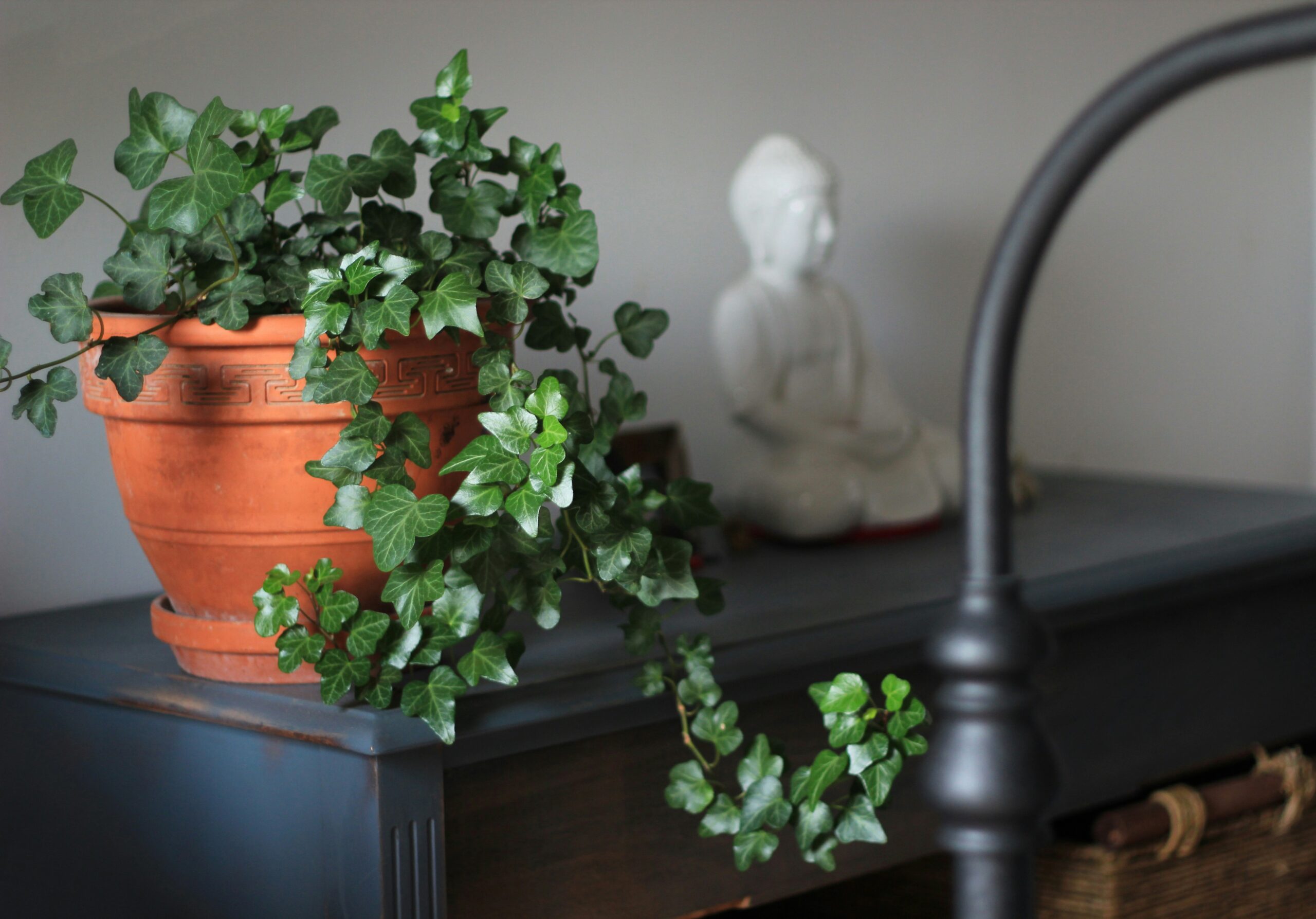
Trailing from a shelf or high surface is the classic look — a pot placed on a bookshelf, a bathroom shelf, or a tall plant stand, with stems allowed to cascade downward. Stems can trail for a metre or more on a healthy plant, creating a dramatic waterfall of foliage. This works particularly well in corners, where the trailing stems soften the hard angle of the room.
Trained upward on a moss pole or wire frame gives a completely different effect — a compact, structured plant rather than a cascading one. Push the stems gently toward the support and they’ll attach using their natural aerial roots. Heart-shaped topiaries and simple obelisk shapes are achievable with a wire frame from any garden centre and a few months’ patience.
In a hanging planter is perhaps the most effective display for ivy — the stems hang freely with no surface to rest on, showing the full length and drape of each trail. Near a north-facing window in a hallway or stairwell is an ideal position.
Mixed with other plants in a large pot or terrarium-style arrangement, ivy provides a living backdrop for plants with more dramatic or colourful foliage. Its fine texture contrasts well with large-leaved tropical plants and it grows happily alongside other shade-tolerant species.
Propagating Indoor Ivy
One of the best things about indoor ivy is how easily it propagates. A healthy plant can produce dozens of new plants from cuttings, making it one of the most generous houseplants to own and share.
Take stem cuttings of about 10cm, cutting just below a leaf node. Remove the lower leaves, leaving two or three at the tip. Place in a glass of water on a bright windowsill and change the water every few days — roots will appear within two to three weeks. Once roots are 2–3cm long, pot up into small pots of multipurpose compost and treat as established plants.
Ivy cuttings root so easily in water that this is an excellent project for children — the roots are visible through the glass and develop quickly enough to hold interest.
The RHS has detailed guidance on caring for indoor ivy including variety recommendations and advice on managing the plant’s more vigorous tendencies, and it’s worth a look if you want to explore beyond the basics.
📖 Also read: How to Grow an Avocado from a Pit — And What Nobody Tells You About It
A Few Final Thoughts
Indoor ivy fails in most homes not because it’s difficult but because it’s misunderstood. It’s a cool-climate woodland plant being asked to live in a warm, dry, centrally heated room — and it struggles under those conditions just as any plant would. Give it a cool spot, bright indirect light, reasonable humidity, and careful watering, and it becomes one of the most reliable and attractive plants in the house.
The reward is a plant that grows fast, looks beautiful in every setting from minimalist to bohemian, costs almost nothing to buy and propagate, and quietly improves air quality in the rooms it inhabits. There’s a reason it appears in virtually every plant styling guide and interior design feature — it just works, when you let it.
Leave a Reply