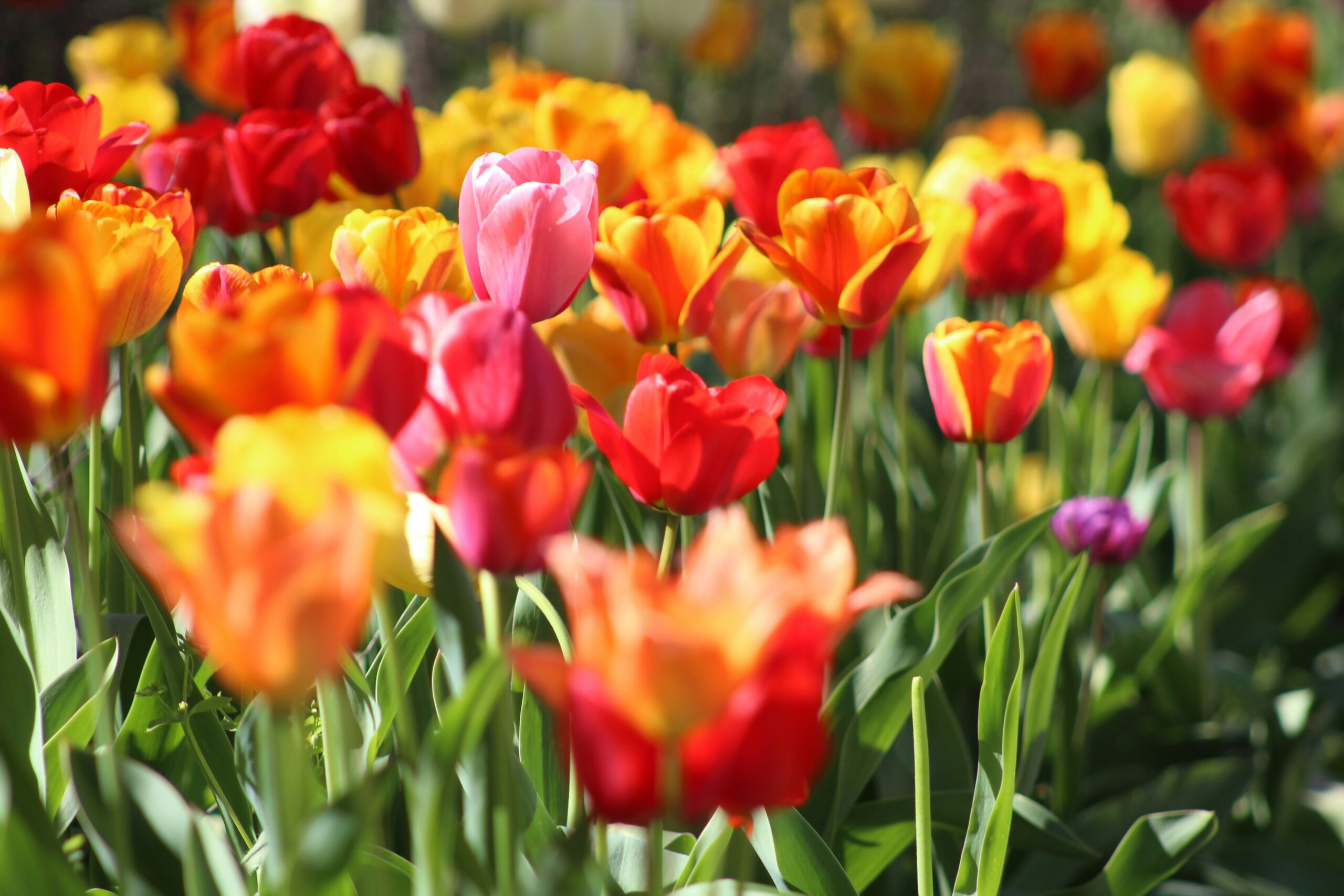
If you want to know how to grow tulips in the UK, you’ve chosen one of the most rewarding and straightforward things a gardener can do in autumn. How to grow tulips in the UK is genuinely simple — plant bulbs in November, do almost nothing through winter, and enjoy weeks of spectacular colour in April and May. Few garden plants deliver quite this ratio of effort to reward, and the range of colours, forms, and flowering times available in the UK means a well-planned tulip scheme can look every bit as impressive as anything you’d see in the gardens of Keukenhof in the Netherlands.
Tulips have a reputation for being complicated — for requiring lifting every year, drying, storing, replanting, and other fussy interventions. Some of this is warranted for specific purposes, but for most UK gardeners growing tulips in beds, borders, and containers, the practical reality is considerably simpler.
Choosing Tulip Varieties
The tulip family is enormous — there are fifteen recognised tulip divisions covering everything from tiny wild species to enormous frilled parrot types — but for a beginner in the UK, a few categories stand out for reliability and impact.
Single early tulips (Division 1) flower in March and early April, making them the first of the large-flowered types to appear. Apricot Beauty and Yokohama are widely available and excellent. Useful for extending the season, particularly in sheltered gardens in the south of England.
Darwin hybrid tulips (Division 4) are the workhorses of the tulip world — large, strong-stemmed, long-lasting flowers in a range of bold colours, flowering in mid-April. They’re the most reliably perennial of the large-flowered tulips, often coming back strongly for three or four years without lifting. Apeldoorn (red), Golden Apeldoorn (yellow), and Pink Impression are the classic varieties.
Single late tulips (Division 5) flower in late April to May and include some of the most elegant and cottage-garden-friendly forms. Queen of Night (deep burgundy-black), Maureen (ivory white), and Dordogne (peachy orange) are outstanding and widely available.
Triumph tulips (Division 3) are mid-season, with classic upright cup-shaped flowers on strong stems. They’re excellent for cutting and available in the widest range of colours. Negrita (purple), Apricot Pride, and Shirley (white with purple feathering) are reliable UK performers.
Parrot tulips (Division 10) produce extravagantly fringed and ruffled flowers in late April to May. Flaming Parrot (yellow with red flames) and Black Parrot (deep purple) are spectacular. They’re less weather-resistant than other types and better suited to a sheltered position or containers.
Species tulips (Division 15) are the wild ancestors — smaller, more delicate, and the most genuinely perennial. Tulipa sylvestris, Tulipa turkestanica, and the cheerful red-and-yellow Tulipa clusiana naturalise happily in well-drained soil and return reliably year after year without lifting.
How to Grow Tulips in the UK: When to Plant
The timing of tulip planting is one of the most important aspects of UK tulip growing, and it differs from most other spring bulbs.
Plant tulips in November — later than most bulb advice suggests, and later than daffodils, alliums, and crocuses, which go in September and October. The reason is fungal disease. Tulips are susceptible to tulip fire (Botrytis tulipae), a disease that spreads rapidly in warm, moist soil. Planting in November, when soil temperatures have dropped below 10°C, significantly reduces the risk of this disease establishing before the bulbs have hardened off.
In the UK, the ideal planting window is the first three weeks of November in most of England and Wales. In Scotland and northern England, where soils cool earlier, late October is acceptable. In mild, wet autumns in the south-west of England, waiting until late November is wise.
There’s no benefit to planting earlier — bulbs planted in September or October in warm UK soils often rot before establishing, whereas November-planted bulbs establish quickly in cool conditions and perform just as well in spring.
Where and How to Plant
Tulips need good drainage above all else. Waterlogged soil is the primary cause of tulip bulb rot and failure. A raised bed, a well-drained border, or a large container gives the best results. If your soil is heavy clay, plant tulips in the highest points of the garden where water drains away, or incorporate generous quantities of grit into the planting area.
Full sun is ideal for most large-flowered varieties. Species tulips are more tolerant of partial shade.
Planting depth: plant at two to three times the depth of the bulb — typically 15–20cm deep for large bulbs. Deeper planting encourages the bulb to perennialise rather than splitting into multiple smaller bulbs, and reduces frost heaving in exposed gardens. Plant with the pointed end upward.
Spacing: 10–15cm between bulbs for a generous, naturalistic display. Closer spacing for a more formal, dense look; wider for a more casual effect.
In containers, tulips are spectacular. Plant bulbs more densely than in the ground — 5–7cm between bulbs — in a good quality peat-free compost with added grit for drainage. Ensure the container has drainage holes. In a large pot, plant in layers — a technique called the “lasagne” method — placing late-flowering varieties at the bottom and earlier ones nearer the top to extend the flowering period from a single container.
After Planting: What to Do (and What Not to Do)
Once planted in November, tulips need almost nothing from you until they flower in spring. Water in if the soil is very dry at planting time, but in a typical UK November this isn’t usually necessary.
Allow the foliage to die back naturally after flowering — at least six weeks, ideally eight. The leaves photosynthesise and replenish the bulb’s energy stores for the following year. Cutting the foliage down early significantly weakens the bulb and reduces next year’s flowering. The dying leaves are admittedly untidy, but planting tulips among emerging perennials or ornamental grasses helps disguise the foliage as it fades.
To Lift or Not to Lift?
This is the question most UK gardeners ask, and the answer depends on the variety and your situation.
Darwin hybrid tulips — the most robustly perennial large-flowered type — can be left in the ground year-round in well-drained soil and will often return for three to five years with good quality flowering. They are the exception rather than the rule among large-flowered types.
Most other large-flowered tulips perform best if lifted after the foliage has died down, dried in a warm airy spot, and stored in paper bags or trays somewhere cool and dry until replanting in November. This is more effort than leaving them in place, but it produces reliably strong flowering year after year and reduces disease build-up in the soil.
If you can’t be bothered to lift — and many gardeners can’t — treat tulips as annuals and buy fresh bulbs each November. Good quality bulbs are relatively inexpensive, and the simplicity of planting fresh bulbs with no storage, disease management, or previous-year sorting to deal with is genuinely appealing. Many of the most spectacular tulip displays in UK public gardens use fresh bulbs every year.
Species tulips should never be lifted — they naturalise in the ground and return reliably year after year without intervention.
📖 Also read: The Complete UK Gardening Calendar — What to Do in Your Garden Every Month of the Year
Tulips in Containers
Container growing is arguably the best way to grow tulips in the UK for several reasons. Drainage is controllable, the display can be positioned anywhere, and lifting and storing (or simply discarding) bulbs from a container is far easier than lifting them from a bed.
Plant into containers in November using peat-free multipurpose compost with added grit or perlite. Water in and then largely leave alone through winter — overwatering dormant bulbs in containers is the most common cause of container tulip failure. Resume careful watering as shoots emerge in spring, increasing as growth develops.
After flowering, you can either lift the bulbs for storage or move the entire container somewhere out of the way while the foliage dies back — replacing it with summer-flowering plants in the main display position. This rotation approach is how many UK gardeners manage seasonal container planting.
Common Problems
Tulip fire (Botrytis tulipae) causes distorted, spotted, or brown-edged leaves and flowers, with fuzzy grey mould on affected tissue in wet weather. It’s the most serious tulip disease in the UK. Affected plants should be removed entirely and disposed of — not composted. The spores persist in the soil, so affected beds should be rested from tulips for three years. Late planting (November) and choosing resistant varieties reduces risk.
Tulip breaking virus causes streaked, feathered, or flamed patterns in the flower petals — the effect that was considered highly desirable and enormously valuable in 17th-century Holland during tulip mania, but which is actually a disease that weakens plants over time. Affected bulbs should be removed and destroyed.
Blind tulips (plants that produce foliage but no flower) are usually caused by bulbs that are too small, damaged, or that have been planted in too much shade. The bulb typically flowers the following year if conditions improve.
Slug damage on emerging shoots in spring can be significant on young plants. Standard slug control measures are worth applying as soon as shoots emerge in March.
The RHS provides a comprehensive guide to growing tulips including detailed variety recommendations, container growing advice, and guidance on managing tulip fire and other diseases.
📖 Also read: Natural Slug Control That Actually Works — No Pellets, No Chemicals, No Nonsense
Tulip Combinations and Garden Design
Part of the pleasure of tulips is the planning — choosing colours, heights, and flowering times that work together and with the rest of the garden.
The most successful tulip schemes in UK gardens tend to work with a limited palette. Three colours used in different proportions — a dominant, a complement, and an accent — produce a more coherent and professional-looking result than a random mix of everything available. The classic purple, white, and acid-green combination (using Negrita tulips with White Triumphator and lime-green euphorbia) is one of the most reliably beautiful spring schemes in the British garden.
Flowering time sequencing: combining early, mid, and late varieties extends the display from late March to late May — six to eight weeks from a single planting effort in November.
Height layering: tall single late types at the back of a border, medium-height Darwin hybrids in the middle, low species tulips at the front creates the same depth and structure in spring that perennial planting provides in summer.
📖 Also read: How to Grow Dahlias in the UK — Big Blooms from a Tiny Budget
A Few Final Thoughts
Tulips are one of the most straightforward ways to dramatically improve the appearance of a UK garden in spring. The investment is modest — a bag of fifty mixed bulbs costs a few pounds — the effort is minimal (a November afternoon of planting), and the reward in April is weeks of colour that arrives exactly when the garden needs it most, after the grey uniformity of a British winter.
Plant in November. Plant deep. Let the foliage die back. Everything else is detail.
Leave a Reply