Yes, perfect — that’s much faster! Here’s #52:
How to Fix Waterlogged Soil in a UK Garden
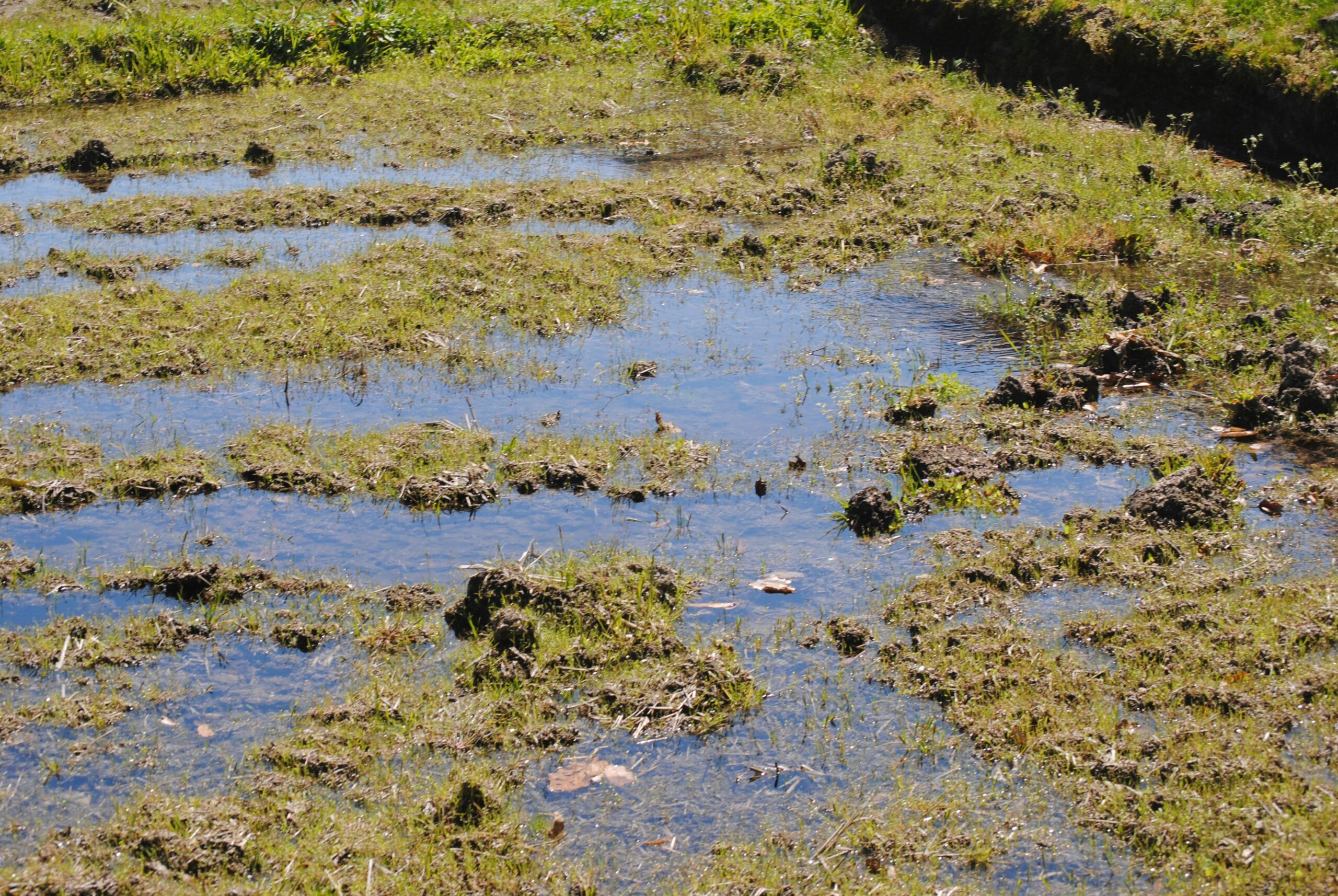
How to fix waterlogged soil in a UK garden is one of those pressing questions that tends to come up after a particularly soggy winter or a week of relentless autumn rain. How to fix waterlogged soil in a UK garden isn’t complicated once you understand what’s causing it — but getting it wrong, or ignoring it altogether, can mean years of struggling with plants that sulk, roots that rot, and borders that look more like bogs than beds.
The good news is that most waterlogging problems are fixable, and some of the solutions are surprisingly simple. Whether you’re dealing with a lawn that squelches underfoot from October to March, a raised bed that never seems to drain, or a heavy clay border where puddles sit for days after rain, there’s a practical answer.
Why Does Soil Become Waterlogged?
Before you can fix the problem, it helps to understand what’s actually happening. Healthy soil is roughly half solid material (minerals, organic matter) and half pore space — small gaps filled with either air or water. Plants need both: water for hydration and nutrient uptake, and air around the roots for respiration. When soil becomes waterlogged, those air pockets fill entirely with water and stay that way, suffocating roots and creating conditions that favour rot over growth.
The most common cause is heavy clay soil. Clay particles are tiny and pack tightly together, leaving very little pore space for water to drain through. After rain, water sits on the surface or moves through the soil extremely slowly. In many parts of the UK — the Midlands, much of Wales, and large parts of northern England — clay-heavy soils are the norm rather than the exception.
Compaction is the second major cause. When soil is walked on repeatedly, especially when wet, the structure is crushed and drainage deteriorates dramatically. This is why lawns in high-traffic areas and vegetable beds where you’ve been treading between rows often develop drainage problems even if the underlying soil isn’t especially heavy.
A high water table — where the natural level of groundwater sits close to the surface — can also cause persistent waterlogging that no amount of surface improvement will completely solve. And sometimes the culprit is simpler: an impermeable layer of subsoil (called a hardpan or an iron pan), or even old building rubble sitting below the surface, that prevents water from percolating downwards.
How to Diagnose the Problem
Before reaching for a spade, it’s worth doing a quick diagnosis. Dig a hole about 30–40cm deep and fill it with water. If it drains away within an hour or two, your drainage is probably adequate and the waterlogging you’re seeing is likely temporary. If the water is still sitting there several hours later, you have a genuine drainage problem.
Also look at what’s growing — or failing to grow. Rushes, sedges, and certain mosses are classic indicators of persistently wet ground. If your lawn is dominated by moss rather than grass, poor drainage is almost certainly part of the reason.
The RHS has a helpful overview of diagnosing and improving soil drainage that’s worth a read if you’re unsure what you’re dealing with.
Fix 1: Improve the Soil Structure with Organic Matter
For most UK gardeners with clay or compacted soil, the single most effective long-term fix is adding organic matter — and lots of it. Compost, well-rotted manure, leafmould, and green waste mulch all work by opening up the soil structure, separating clay particles, and creating larger pore spaces through which water can drain freely.
This isn’t a one-season job. Heavy clay soil that’s been compacting for years won’t transform after a single barrowload of compost. The approach that works is consistent, generous application year after year — ideally a 5–10cm layer of well-rotted organic matter spread over the surface each autumn and allowed to be worked in by worms over winter. After two or three years of this, most clay soils show a marked improvement in drainage and workability.
Grit — specifically horticultural or coarse sharp grit, not builder’s sand — can also be incorporated to open up clay structure. The quantity required to make a meaningful difference is larger than most people expect: at least a bucketful per square metre worked into the top 30cm of soil. Small amounts of grit mixed into heavy clay can actually make things worse by creating a concrete-like mixture.
📖 Also read: The Simple Soil Guide Every UK Gardener Needs
Fix 2: Aerate Compacted Soil
If compaction rather than clay is the primary issue, aeration is the most direct solution. On a lawn, this means using a hollow-tine aerator — either a manual one or a hired machine for larger areas — to remove plugs of soil and create channels through which air and water can move. This is best done in autumn, after which you brush sharp sand into the holes to keep them open.
For borders and vegetable beds, the equivalent is deep digging — or better still, using a garden fork pushed in to its full depth and rocked backwards and forwards to fracture the soil without inverting it. This preserves the structure and the soil life while breaking up the compacted layer.
The golden rule going forward: never walk on wet soil. Use planks or stepping stones to distribute your weight in vegetable beds, and avoid working on borders when the ground is sodden. The damage done by a single walk across a wet clay bed can take months to undo.
Fix 3: Install Drainage
Where organic matter and aeration aren’t enough — particularly in areas with a genuinely high water table or an impermeable subsoil layer — physical drainage may be necessary.
The simplest form is a soakaway: a large pit dug to at least a metre deep and filled with coarse rubble or gravel, positioned at the lowest point of the garden. Water naturally drains towards it and then percolates slowly away. A soakaway works well in gardens where the problem is temporary pooling after rain rather than persistent saturation.
For more serious problems, French drains are the next step up. These are trenches filled with gravel and containing a perforated pipe that channels water away to a soakaway, a ditch, or a drain. Laying a French drain is a significant project — the trenches need to be dug at the right gradient (about 1:100) and the pipe laid correctly — but for a garden that’s been unworkable in winter for years, it can be transformative.
Before installing any drainage that connects to a watercourse or public drain, check with your local council about permitted development rules.
Fix 4: Raise the Growing Level
Sometimes the simplest answer to waterlogged ground is to stop fighting it at ground level and grow above it instead. Raised beds filled with good quality topsoil and compost sit above the saturated zone and drain freely regardless of what’s happening below. In gardens with genuinely intractable drainage problems — heavy clay over a hardpan, or a naturally boggy site — raised beds can allow you to grow a wide range of vegetables and flowers that would struggle in the ground.
Even a modest raise of 20–30cm makes a meaningful difference to drainage. For permanent raised beds on very wet ground, consider lining the base with a layer of coarse gravel before adding topsoil, to encourage any water that does penetrate to drain away rather than sit.
📖 Also read: How to Build a Raised Bed Garden from Scratch
Fix 5: Choose Plants That Tolerate Wet Conditions
If you have an area of the garden that’s reliably damp — a low-lying corner, a spot near a downpipe, a naturally boggy patch — it may be more sensible to work with the conditions than against them. There are many beautiful plants that genuinely prefer or tolerate waterlogged soil, and a well-planted bog garden can be one of the most striking features in a British garden.
Astilbes, hostas, ligularias, and candelabra primulas all thrive in reliably moist ground. For trees and shrubs, willows and alders are naturally waterside plants. Iris pseudacorus (yellow flag iris) and Caltha palustris (marsh marigold) are native British wildflowers that will colonise a boggy area and look stunning in spring.
This approach is particularly worth considering in areas where the waterlogging is seasonal — wet over winter, drier in summer — as many bog plants are happy with this cycle.
Waterlogged Soil in Pots and Containers
Waterlogging isn’t only a ground-level problem. Pots and containers can become waterlogged too, particularly if drainage holes are blocked, if saucers are left full of water in winter, or if a peat-heavy compost has broken down into an impermeable mass.
The fix is straightforward: check that drainage holes are clear, empty saucers after rain, and repot into fresh compost if the existing mix has become compacted and water-repellent. Adding a layer of crocks (broken terracotta pot shards) or coarse gravel at the base of the pot before compost goes in helps maintain drainage over time.
The Long View
Waterlogged soil is one of the more demoralising problems in the garden, especially in a British winter when it seems like the rain will never stop and every border is a quagmire. But it’s worth remembering that improving drainage is cumulative — every barrowload of compost you dig in, every pass of the fork, every raised bed you build, makes the ground a little more workable than it was before.
Most UK gardens with drainage problems can be significantly improved within two to three seasons with consistent attention. The key is understanding what’s causing the waterlogging, choosing the right fix, and then sticking with it rather than giving up after one wet November.
📖 Also read: Why Is My Compost Slimy and Smelly?
Leave a Reply