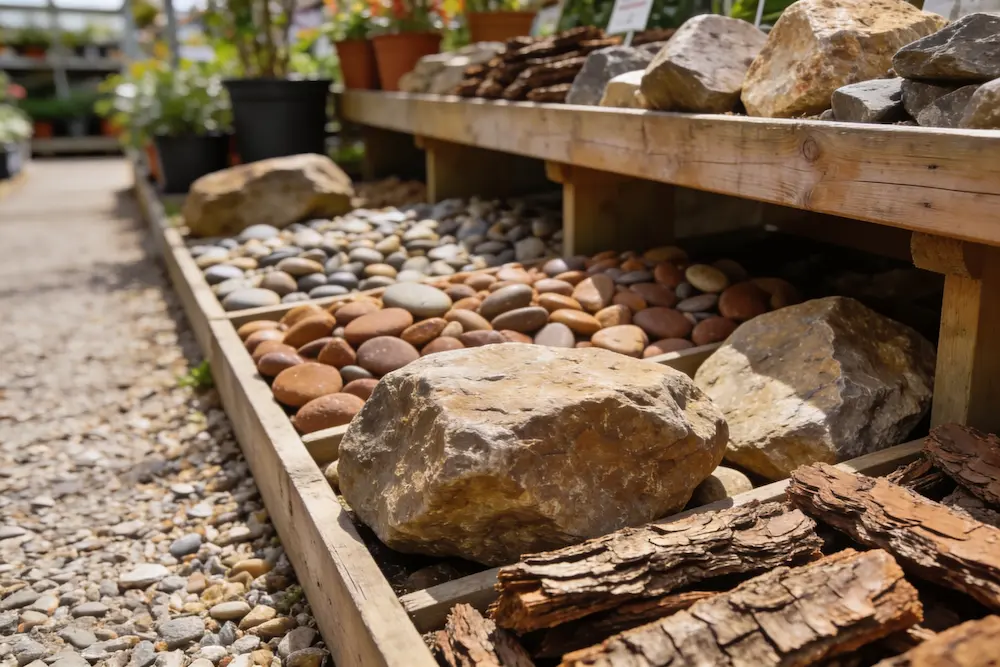
Rocks, pebbles and bark UK garden materials are among the most useful — and most misused — choices in hard landscaping. Used well, they suppress weeds, retain moisture, improve drainage, add texture and year-round visual interest, and reduce the amount of time you spend on maintenance. Used carelessly — dumped uniformly across a border, deployed without thought for drainage or plant type, or chosen purely for price — they create new problems while solving none of the old ones. Understanding which material does what, and where each one genuinely earns its place, makes the difference between a garden that looks considered and one that looks like a builder’s yard with flowers in it.
This guide covers all the rocks, pebbles and bark UK garden options — decorative bark, wood chip, gravel, cobbles, and larger rocks — with honest advice on where each one works best, where it doesn’t, and what to watch out for when buying and laying them.
📖 Also read: How to Plan Your Garden
Bark and Wood Chip — The Workhorse Mulch
For rocks, pebbles and bark UK garden projects, bark mulch and wood chip are the most widely used materials, and for good reason: applied correctly, they’re genuinely effective at suppressing annual weeds, locking moisture into the soil, moderating soil temperature, and gradually improving soil structure as they break down. A 7–10cm layer of bark mulch applied around shrubs and perennials in spring or autumn reduces watering frequency, significantly reduces weeding, and makes borders look immediately neater and more deliberate.
The distinction between bark mulch and wood chip matters. Decorative bark (sometimes sold as “ornamental bark” or “bark chippings”) is processed from bark only, is relatively fine and consistent in texture, and decomposes more slowly than wood chip. It’s better suited to ornamental borders where appearance matters. Wood chip — the chipped material from whole branches, often available free or cheaply from tree surgeons and local councils — is coarser, more variable in texture, and richer in carbon as it breaks down. It’s excellent for paths, play areas, and more naturalistic planting schemes, but it should not be dug into the soil while fresh, as the decomposition process temporarily depletes soil nitrogen.
Both materials migrate over time — they’re light enough to be kicked out of beds by foot traffic and to wash off slopes in heavy rain. On flat beds away from paths, this is rarely a problem. On slopes or alongside paths, a firm edging strip keeps the material in place and significantly reduces the need for topping up.
📖 Also read: Simple Soil Guide for UK Gardeners
Gravel — Drainage, Texture, and Versatility
Gravel is the most versatile hard landscaping material available in a UK garden and arguably the most underused. It’s inexpensive, extremely durable (it essentially never needs replacing), excellent for drainage, and works beautifully in both formal and informal settings. A gravel mulch over a planted bed suppresses weeds, prevents soil splash onto foliage (which reduces fungal disease), and drains so freely that it’s the ideal surface for plants that resent waterlogging — Mediterranean herbs, lavender, drought-tolerant perennials, and many alpine species all thrive with a gravel mulch around their base.
For paths and informal surface areas, self-binding gravel (a mix of small gravel and fine particles that compacts to a firm surface underfoot) is one of the most cost-effective and attractive surfacing options in UK gardening. It works well in both formal gardens — the classic country house path surface — and informal cottage settings. Loose pea gravel is less practical for paths (it shifts underfoot and tracks into the house) but excellent as a mulch in beds and borders where foot traffic is minimal.
Colour and origin matter more than most buyers realise. Locally quarried gravel tends to look more natural and at home in a UK garden than imported materials — golden flint gravel suits warm-coloured brick buildings; pale grey or blue-grey slate chippings work with contemporary grey render or timber; warm buff limestone suits Cotswold stone houses. Matching the gravel to the dominant material in your house exterior is one of the simplest design decisions you can make and produces the most coherent result.
Pebbles and Cobbles — Decorative Detail and Problem Solving
Smooth pebbles and cobbles are the rocks, pebbles and bark UK garden element most people underestimate. They are primarily decorative rather than functional, but they earn their place in several specific applications. Around the base of a pond or water feature, smooth river pebbles create the naturalistic shoreline effect that makes a water feature look embedded in the garden rather than dropped onto it. Laid over a drainage channel or in a dry stream bed, larger cobbles create visual interest while allowing water to flow through freely — an attractive and practical solution for gardens with drainage challenges.
Pebbles also work well as a mulch in containers — a layer of smooth pebbles over the compost surface looks attractive, reduces moisture evaporation, prevents compost splash, and deters vine weevils from laying eggs in the compost. For large statement pots and specimen plants in prominent positions, a decorative pebble mulch elevates the whole display significantly.
The main thing to avoid with pebbles is using them as a weed suppressant in open ground. Unlike gravel (which is fine enough to be difficult for weeds to establish in) or bark (which breaks down to enrich the soil), pebbles provide neither suppression nor any soil benefit — weeds establish readily in the gaps and are harder to remove from between smooth stones than from bare soil. Pebbles as a large-area ground cover without a weed-suppressant membrane beneath them create more maintenance than they prevent.
📖 Also read: How to Fix Waterlogged Soil
Larger Rocks and Boulders — Structure and Naturalism
A single well-placed boulder does more for a garden than a barrowload of small pebbles scattered randomly. Large rocks — whether local sandstone, limestone, or imported basalt — bring genuine permanence and weight to a garden composition, grounding planting and creating focal points that function throughout all four seasons, long after the flowers have come and gone. In a rock garden or gravel garden context, large stones placed at natural angles (as if they’ve always been there, partially buried rather than sitting on top of the soil) create the impression of a geological feature rather than a pile of stones.
When it comes to the rocks, pebbles and bark UK garden hierarchy, large rocks are the most structural element. The key design principle is restraint and intentionality. Three large boulders of the same type, positioned with thought and partially sunk into the ground, look like a landscape feature. Fifteen randomly assorted rocks of different sizes and types scattered across a lawn look like a delivery that was never unpacked. Source rocks locally where possible — stone that matches the local geology always looks more natural, and locally sourced material is far cheaper to transport than imported equivalents.
For a rock garden or alpine planting, the gaps between rocks are as important as the rocks themselves. Plants like thyme, creeping phlox, sedums, and saxifrages colonise the crevices between stones beautifully, softening the hard edges and creating the naturalistic effect that makes a good rock garden look like a mountainside in miniature rather than a pile of rubble with plants stuck in it.
Weed Membrane — Use It Wisely or Not at All
For more guidance on mulching best practice, the RHS mulching guide covers the main options in detail. Weed-suppressant membrane under gravel and bark is a controversial subject among UK gardeners, and rightly so. Used under a gravel path or a hard surface area with no planting, a good quality woven geotextile membrane is effective and worthwhile — it prevents weed establishment for many years and makes the installation genuinely low-maintenance. Used under a planted border with bark or gravel mulch, the picture is very different.
Membrane under planted borders prevents organic mulch from integrating with the soil beneath, stops earthworms from doing their work, impedes root development of established plants, and — critically — does not prevent weeds for more than a few years. Weed seeds blow in and germinate on top of the membrane in the accumulated organic matter. The roots of these weeds then grow through the membrane, making them far harder to remove than weeds growing in bare soil. Long-term, membrane under planted borders creates significantly more work than bare soil mulched with bark or compost alone. Use it for paths and surfaces; avoid it under planting.
📖 Also read: Garden Paths — DIY Ideas for UK Gardens
Slate Chippings — Contemporary Style and Practical Benefits
When choosing rocks, pebbles and bark UK garden materials, slate chippings deserve special attention. Blue-grey slate chippings have become one of the most popular decorative mulch materials in UK gardens over the last decade, and their popularity is largely deserved. They look sharp and contemporary, they don’t fade or decompose (unlike bark), they suppress weeds effectively when laid at sufficient depth (5–7cm minimum), and they complement a wide range of planting styles from modern minimalist to architectural Mediterranean. They’re particularly effective around ornamental grasses, phormiums, agapanthus, and other bold, structural plants where a clean, dark-toned ground surface allows the foliage to stand out clearly.
The main practical consideration is that slate chippings, like all hard mulches, don’t improve the soil beneath them. If you’re using slate in a planted border for the long term, incorporate organic matter into the soil before laying the chippings, and top-dress with compost annually by working it in around plant bases rather than over the whole surface. This maintains soil health without disturbing the decorative surface significantly.
Rocks, Pebbles and Bark UK Garden — Which Material Should You Choose?
The honest answer to which rocks, pebbles and bark UK garden combination to choose is almost always: more than one. Most well-designed UK gardens use bark or wood chip in planted borders, gravel or self-binding gravel on paths and open surfaces, a hard mulch like slate or pea gravel around specimen plants and water features, and larger rocks or boulders as deliberate structural elements in specific parts of the garden. These materials are not competing with each other — each does something different, and a garden that uses them with purpose and proportion will always look more considered than one that has chosen a single material and applied it everywhere.
With rocks, pebbles and bark, UK garden problems from weed pressure to poor drainage can often be solved with the right material laid correctly. Start with the problem — weed suppression, drainage, aesthetics, surface stability — and work back to the material that addresses it most effectively. That approach will serve your garden far better than picking whatever looks attractive at the garden centre and hoping for the best.
📖 Also read: Vertical Gardening in the UK
Leave a Reply