If you want to grow dahlias in the UK, you’ve picked one of the most rewarding things you can do in a British garden. Learning how to grow dahlias in the UK doesn’t require a large plot, specialist knowledge, or a particularly generous budget — a single tuber bought in spring for a couple of pounds can produce dozens of flowers from July right through to the first frosts of October. No other plant in the British garden gives you quite that much for quite that little.
The dahlia revival that’s been building over the past decade shows no sign of slowing. What was once seen as a slightly old-fashioned show garden flower — something your grandad grew in rows on an allotment in Sheffield — has become one of the most photographed and coveted plants on social media. And for once, the hype is entirely deserved.
This guide covers everything a beginner needs to know: tubers vs. seeds, when and where to plant, how to get the most flowers, what can go wrong, and why dahlias are genuinely one of the best value plants you can put in the ground.
How to Grow Dahlias in the UK: Starting with the Right Type
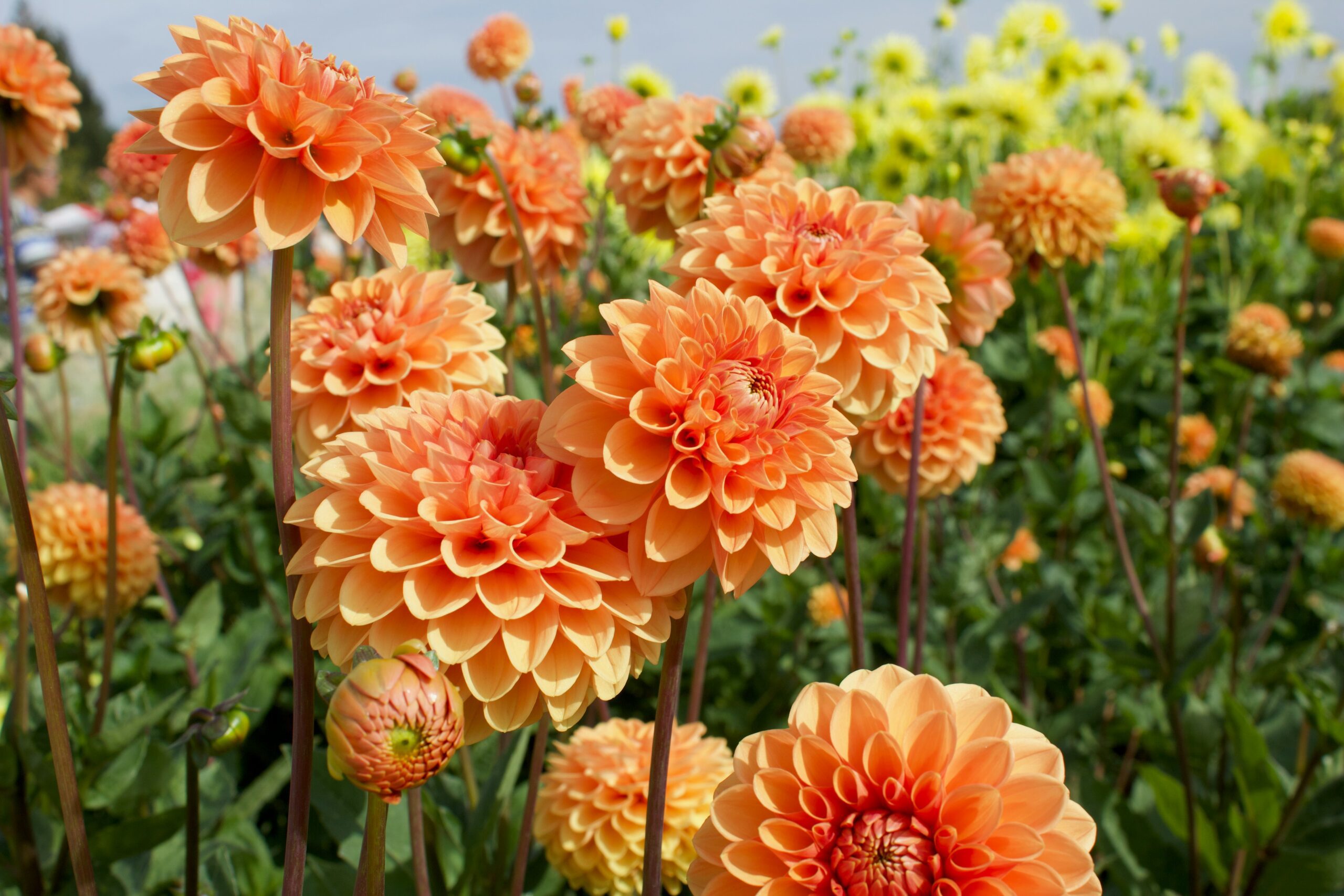
Dahlias come in a bewildering range of sizes and flower forms — dinner-plate dahlias the size of a side plate, tight pompom varieties, spiky cactus types, and simple single-flowered forms that are brilliant for pollinators. Before anything else, it’s worth deciding what you actually want from the plant.
For beginners, medium-sized decorative or ball dahlias are the most reliable starting point. They’re sturdy enough to hold their heads up without constant staking, produce a huge number of flowers, and come in a range of colours that work well in mixed borders. Varieties like Totally Tangerine, Bishop of Llandaff (a UK favourite with deep red flowers and near-black foliage), and the Café au Lait type — creamy pink, incredibly photogenic — are all widely available and reliably good.
Dinner-plate dahlias are spectacular but need more support and are more prone to wind damage. Save those for once you know how your garden behaves in summer.
Single-flowered dahlias like the Bishop series are excellent if you want to support bees and hoverflies — their open centres make pollen accessible in a way that the more complex forms don’t. They’re also extremely free-flowering.
Where to Plant Dahlias in the UK
Dahlias are sun lovers. They want a spot that receives at least six hours of direct sunlight daily — in a British summer, that typically means a south or west-facing position with nothing blocking the afternoon sun. In shadier spots they’ll grow, but they’ll be leggier, produce fewer flowers, and be more prone to slug damage on those long soft stems.
Good drainage is the other non-negotiable. Dahlia tubers sitting in cold, wet soil will rot, particularly in the weeks after planting when soil temperatures are still low. If your garden has heavy clay that holds water, either improve it with grit and compost before planting, or grow your dahlias in large containers where you control the drainage entirely.
Shelter from wind matters more than most beginner guides acknowledge. Dahlias grow fast and tall — some varieties will reach 1.2m to 1.5m by August — and British summer storms can flatten them if they’re planted in an exposed spot. A fence, hedge, or wall nearby makes a real difference.
📖 Also read: How to Build a Raised Bed Garden from Scratch — Everything a UK Beginner Needs to Know
When to Plant Dahlia Tubers in the UK
Timing is one of the few areas where dahlia growing requires a little patience. Tubers should not go into the ground until the risk of frost has genuinely passed — in most parts of England and Wales that means late April to mid-May. In Scotland, the north of England, and exposed upland areas, wait until late May.
Dahlias are completely frost-tender. A late frost after planting will kill the emerging shoots, and though the tuber itself often survives and regrows, it sets you back by weeks. Check the forecast for your area before you plant, and if in doubt, wait.
You can get a head start by potting tubers up indoors in March or early April. Use a pot just large enough to fit the tuber, fill with peat-free multipurpose compost, water sparingly, and place somewhere bright and frost-free — a greenhouse, a conservatory, or a sunny windowsill. By the time it’s safe to plant outside in late April or May, you’ll have a strong plant already in growth, and it will flower several weeks earlier than a tuber planted straight into cold ground.
Plant tubers at a depth of about 10cm, with the central growing eye (a small bud, sometimes hard to spot) facing upward. If you can’t identify the eye clearly, plant the tuber on its side — it will find its way.
Planting, Feeding and Getting the Most Flowers
When planting dahlias outside, dig a hole generously larger than the tuber and work in a good amount of garden compost or well-rotted manure. Dahlias are hungry plants, and they respond visibly and immediately to rich soil.
Insert a stake at planting time, before the plant is in the ground. Trying to stake a metre-tall dahlia in August without spearing the tuber is both frustrating and unnecessary.
Once the plant reaches about 40–45cm tall, pinch out the growing tip — cut or snap out the central stem just above a pair of leaves. This sounds counterintuitive (you’re removing growth you waited weeks for) but it forces the plant to branch outward, producing many more flowering stems rather than one tall central spike. This single action probably doubles the number of flowers you’ll get.
Feed regularly from June onwards. A high-potassium liquid feed — tomato feed works perfectly well — applied once a week encourages flower production over leafy growth. Stop feeding by late August.
Deadhead consistently. Removing spent blooms before they set seed keeps the plant focused on producing new flowers rather than redirecting energy into seeds it doesn’t need to produce. In a good season, a well-deadheaded dahlia will be in almost constant flower from July to October.
📖 Also read: How to Make Free Liquid Fertiliser from Weeds (And Why It Works Better Than You’d Think)
Common Problems When Growing Dahlias in the UK
Slugs and snails are the number one pest for dahlias, particularly when shoots are first emerging in spring. The soft new growth is exactly what they’re looking for. Vigilance is needed from the moment shoots appear — a single hungry night for a slug can wipe out a newly emerged dahlia to soil level. Copper tape around pots, wool pellets, or nightly checks with a torch and a bucket are all effective.
📖 Also read: Natural Slug Control That Actually Works — No Pellets, No Chemicals, No Nonsense
Earwigs can be a significant problem by midsummer. They feed on petals at night, leaving ragged holes that ruin otherwise perfect flowers. A classic allotment trick is to stuff an upturned flower pot with straw and balance it on a cane near the dahlias — earwigs shelter in it during daylight, and you can empty and dispose of them each morning.
Vine weevil is worth knowing about if you’re growing in containers. The grubs feed on roots and tubers underground, and often you don’t know there’s a problem until the plant collapses. Use a biological control (nematodes applied in late summer or autumn) if you’ve had problems before.
Powdery mildew can appear in dry late summers, coating leaves with a white dusty film. It won’t kill the plant, but it looks poor and can weaken it. Improve air circulation by removing some leaves from congested plants, and keep roots moist.
Lifting and Storing Dahlia Tubers Over Winter
This is where many beginners are uncertain, and honestly, there are two valid approaches. In mild parts of the UK — coastal areas, the south-west, and sheltered urban gardens — dahlias can often be left in the ground over winter with a thick mulch of bark or straw over the crown. This works more often than it fails, and the tubers you dig up the following spring will be substantially larger than when you planted them.
In colder regions, or if you’ve invested in expensive varieties you’d rather not risk, lift the tubers after the first frost blackens the foliage. Cut the stems down to about 15cm, use a fork to ease the tuber clump out of the ground carefully, and shake off excess soil. Leave them upside down for a few days somewhere frost-free to drain and dry. Then pack them in boxes of barely damp compost, coir, or vermiculite and store somewhere cool, dark, and frost-free — a garage or cellar is ideal — until planting time comes around again in spring.
The RHS recommends checking stored tubers periodically over winter for rot, removing any affected sections with a clean knife to prevent spread. Their full guidance on overwintering dahlias covers both methods in detail and is worth bookmarking.
Growing Dahlias on a Budget
The “tiny budget” in the title isn’t exaggeration. Dahlia tubers from garden centres and online suppliers like Sarah Raven or Suttons typically cost between £3 and £8 each. But if you lift and store them each year — or even just mulch and leave them — one tuber becomes a clump within two seasons that you can divide into several separate plants.
Dividing dahlias is straightforward. In spring, when stored tubers are showing small pink eyes (buds), use a sharp clean knife to cut the clump so that each section has at least one eye and a piece of the main stem neck attached. Each division grows into a full-sized plant that flowers identically to the parent.
Buy three good dahlias in year one. Lift, store, and divide in year two. By year three, you can have twelve or fifteen plants for the price of the original three. It’s one of the best investments in the garden.
A Few Final Thoughts
Dahlias reward attention but they don’t punish neglect too harshly. Miss a week of deadheading and the plant carries on. Forget to pinch out and you’ll still get flowers, just fewer of them. They’re genuinely one of the most satisfying plants to grow in the UK, not just because of what they produce but because of the pace at which they do it — you can almost watch them grow in a good July.
If you’ve been meaning to try dahlias but kept putting it off, this is the year to start. A tuber from your local garden centre, a sunny spot, and a stake — that’s really all you need.
Leave a Reply