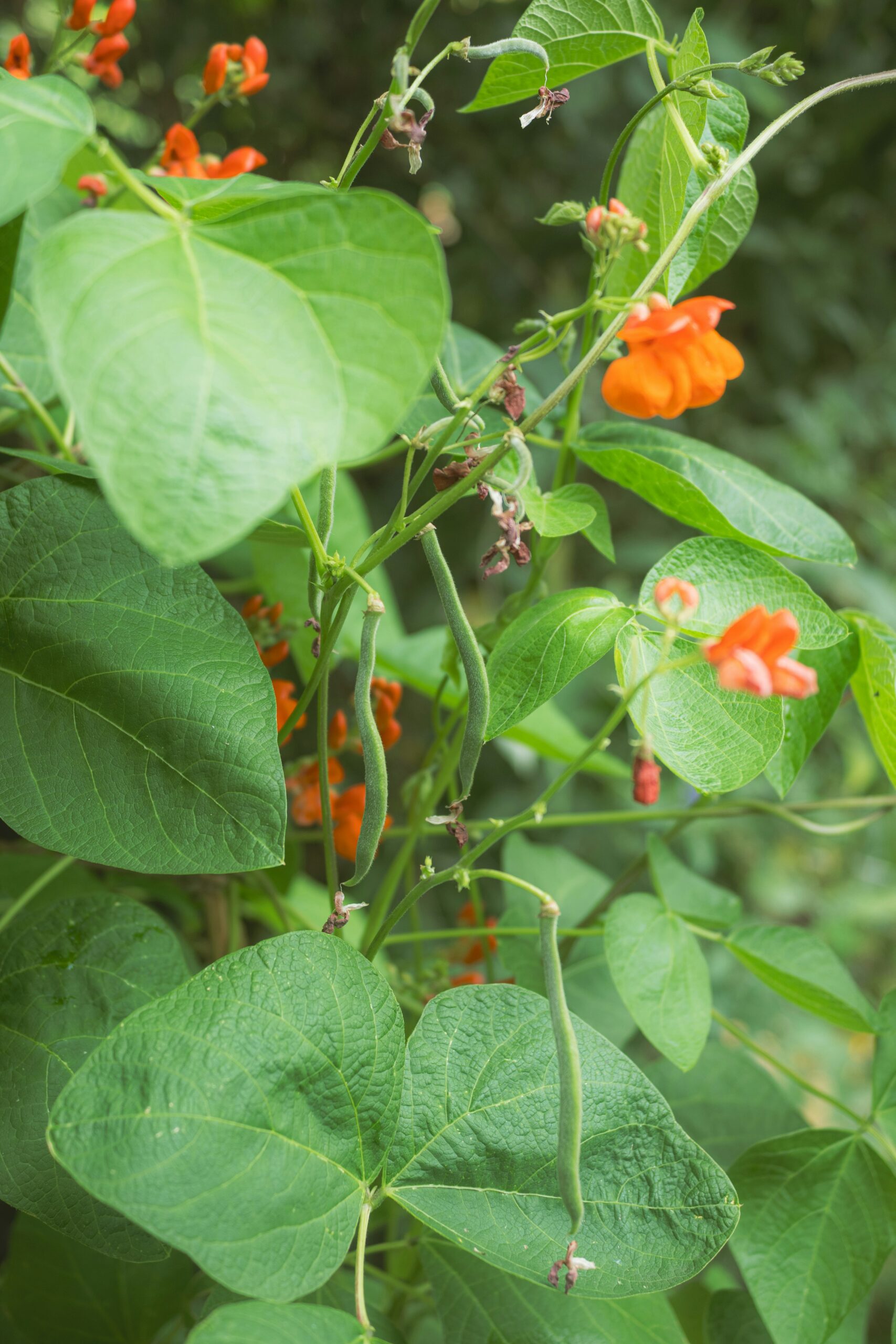
If you want to know how to grow runner beans in the UK, you’ve picked one of the most rewarding crops a British beginner can start with. Runner beans are fast, reliable, spectacularly productive, and almost perfectly suited to the UK climate — they actually prefer the cool, moist summers that frustrate gardeners trying to grow more heat-demanding crops. Learning how to grow runner beans in the UK means understanding a plant that, once established, will produce more food per square metre than almost anything else in the kitchen garden from July to October.
The scarlet flowers alone are worth growing them for. A wigwam of runner beans in full bloom in July is genuinely beautiful — ornamental enough to earn a place in a mixed border as well as a vegetable plot — and the deep red flowers are outstanding for bumblebees throughout the summer.
Choosing a Runner Bean Variety
Runner beans don’t have the bewildering range of varieties that tomatoes or courgettes offer, but the choice still matters for UK growing conditions.
Scarlet Emperor is the classic British runner bean — widely grown for generations, reliable, heavy-cropping, and producing the long, flat pods most people picture when they think of runner beans. It’s the standard against which everything else tends to be judged, and it remains excellent.
Enorma lives up to its name, producing exceptionally long pods — up to 50cm — on vigorous plants. It’s one of the most popular show varieties in the UK and performs well in kitchen gardens too.
Painted Lady is a heritage variety with bicoloured red and white flowers, making it particularly attractive in an ornamental setting as well as productive for the kitchen. It’s been grown in Britain since at least the 17th century.
Hestia is a dwarf variety that reaches only about 45cm and needs no staking — ideal for containers, small raised beds, or exposed gardens where tall climbing structures are impractical. It’s not as productive as the full-sized climbing varieties but makes runner beans accessible without the need for a support structure.
White varieties such as White Emergo and Moonlight have white flowers and white seeds. They’re sometimes considered slightly less stringy than red-flowered varieties and have a loyal following among UK kitchen gardeners.
For a first season, Scarlet Emperor or Enorma in a standard climbing situation is the most straightforward and satisfying choice.
How to Grow Runner Beans in the UK: Sowing
Runner beans are frost-tender and must not go outside until the risk of frost has passed. In the UK, this means a choice between starting indoors or waiting to sow directly outside.
Sowing indoors (April to early May) gives plants a head start and produces an earlier harvest. Sow one bean per 9cm pot at a depth of 5cm in peat-free multipurpose compost. Place on a bright windowsill or in a greenhouse at around 15–18°C. Germination is fast — often within five to seven days. Don’t start too early: runner beans grow quickly and a plant started in March will be pot-bound and frustrated before it’s safe to go outside.
Sowing directly outside (mid-May to early June) is perfectly effective and avoids the transplant step. Wait until soil temperature is at least 12°C — a reliable guide is to sow when hawthorn is in full flower, which broadly corresponds with frost risk reducing in most of England and Wales. Sow at 5cm depth, two seeds per cane position, and thin to one plant per station if both germinate.
In Scotland and northern England, where last frosts can extend into late May, indoor sowing with a mid to late May planting-out date is the more reliable approach.
Building the Support Structure
The support structure for runner beans needs to be in place before the plants go out — trying to erect one around established plants is awkward and risks damaging stems.
The traditional double row is the most space-efficient method for a vegetable plot. Push canes into the ground in two parallel rows, 45cm apart, spacing canes 30cm apart within each row. Cross each pair of canes at the top and tie them together, then run a horizontal cane along the top of the X-frames for additional stability. This structure handles the considerable weight of a full crop in late summer and the wind resistance of dense foliage.
A wigwam of six to eight canes pushed into the ground in a circle and tied at the top is the classic alternative — more ornamental, works well in borders and raised beds, and is self-stabilising. Plant one bean at the base of each cane.
Canes should be at least 2.4m tall — runner beans are vigorous and will reach the top of a 2.4m cane in a good season. Tying a horizontal cane or string across the top of a wigwam extends the effective growing height slightly.
Netting between canes works as an alternative to individual canes for the beans to climb, though it’s harder to dismantle at the end of the season and more prone to wind damage.
📖 Also read: How to Build a Raised Bed Garden from Scratch — Everything a UK Beginner Needs to Know
Planting Out and Early Care
Plant out hardened-off seedlings from mid-May in southern England, late May to early June further north. Space one plant per cane, or 30cm apart in a row. Plant firmly and water in well.
Runner beans are nitrogen-fixing — their roots harbour bacteria that take nitrogen from the air and convert it to a form usable by plants. This means they’re less hungry than many vegetables, but they still benefit from a soil that has had compost or well-rotted manure worked in before planting.
The first two weeks after planting out require some attention. Young plants are vulnerable to slug damage — the emerging shoots are soft and appealing — and to cold snaps that check growth. Keep an eye on the forecast and have some fleece on hand for the first few weeks.
Guide the first few stems toward the canes — they’ll find them quickly, but a loose tie at the base encourages them in the right direction. Once the tendrils have gripped the cane, the plant climbs confidently without further guidance.
Water regularly once plants are in growth. Runner beans are shallow-rooted and suffer in dry spells — irregular watering is one of the main causes of flower drop, which leads directly to poor pod set.
Watering, Feeding, and Encouraging Pods
Watering consistently is the single most important thing you can do for runner beans once they’re in flower. The flowers are pollinated by bumblebees, and a well-watered plant with fully open, nectar-rich flowers will be visited far more consistently than a stressed, dry plant. Flower drop — where flowers fall without setting pods — is almost always caused by dry conditions at the root.
Water at the base of the plants rather than overhead. A deep watering every two to three days in dry weather is far better than a daily sprinkle. Mulching around the base of the plants with compost or bark reduces moisture loss significantly.
Feeding is less critical for runner beans than for fruiting crops like tomatoes or courgettes, but a fortnightly liquid feed with a balanced fertiliser once pods are forming encourages continued production through August and September.
Pinching out the growing tips when plants reach the top of their support — or when you want to stop upward growth — redirects the plant’s energy into producing side shoots and pods rather than extending the main stems further.
📖 Also read: How to Make Free Liquid Fertiliser from Weeds (And Why It Works Better Than You’d Think)
Harvesting — Pick Early, Pick Often
Runner beans must be picked regularly to keep the plant producing. This is the same principle as sweet peas, courgettes, and most other productive garden crops: leaving mature pods on the plant signals that reproduction is complete, and production slows or stops.
Pick pods when they’re 15–20cm long and still flat — the beans inside should be just detectable as small bumps but not yet bulging. At this stage the pods are tender, string-free, and at their best for cooking. Left to grow, the pods become tough, stringy, and the beans inside develop fully — at which point you can shell them as fresh beans, or leave them to dry completely for dried beans to store over winter.
Check plants every two to three days at the height of the season in July and August. In a good year, two established double rows will produce more beans than a family of four can eat — the classic British problem of runner bean abundance. They freeze well: blanch for two minutes, cool in iced water, dry thoroughly, and freeze in portions.
Common Problems
Flower drop without pod set is the most common runner bean complaint in the UK. The causes, in order of likelihood, are: dry soil at the roots, cold nights that deter pollinating bees, and — more rarely — too much nitrogen in the soil producing lush leafy growth at the expense of flowering. Address watering first, then review feeding.
Slugs target seedlings and young plants. Protection measures at planting time and for the first two weeks are well worth the effort.
Black bean aphid (blackfly) often colonises the growing tips of runner beans in June. Pinch out the growing tip if it’s heavily infested, squash colonies by hand, or use a soap spray on established infestations. Natural predators — ladybirds and lacewings — will catch up with the population if you give them time.
Halo blight is a bacterial disease causing water-soaked spots with yellow halos on leaves, spread through infected seeds and wet weather. Buy seed from reputable UK suppliers and avoid working among plants when foliage is wet.
Bean seed fly can damage seeds sown directly into cold, slow-warming soil. Warming the soil with cloches for a couple of weeks before direct sowing reduces risk, as does starting indoors where germination conditions can be controlled.
The RHS has a comprehensive guide to growing runner beans covering variety selection, crop rotation, and pest management in more detail.
📖 Also read: Natural Slug Control That Actually Works — No Pellets, No Chemicals, No Nonsense
Saving Seed for Next Year
Runner beans are one of the easiest vegetables to save seed from. At the end of the season, leave a few of the best-looking pods on the healthiest plants to dry completely on the vine. Once the pods have turned papery and brown and the beans inside rattle when shaken, pick and shell them. Spread the beans on newspaper to dry completely indoors for a further two weeks, then store in a paper envelope in a cool, dry place.
Runner bean seeds remain viable for three to four years when stored correctly. Saved seed from open-pollinated varieties comes true — your Scarlet Emperor seeds will produce Scarlet Emperor plants. Saved seed from F1 hybrid varieties will not come true and should be bought fresh each year.
A Few Final Thoughts
Runner beans are one of the great British kitchen garden crops for very good reasons. They suit the climate, they produce generously, the flowers are beautiful, and the harvest — picked young and eaten the same day — is nothing like anything available in a supermarket. The structure required is straightforward to build, the plants look after themselves once established, and the whole season from sowing to last harvest takes you from late April to October.
If you have room for a wigwam or a double row of canes, you have room for one of the most productive and satisfying crops the British kitchen garden offers.
Leave a Reply