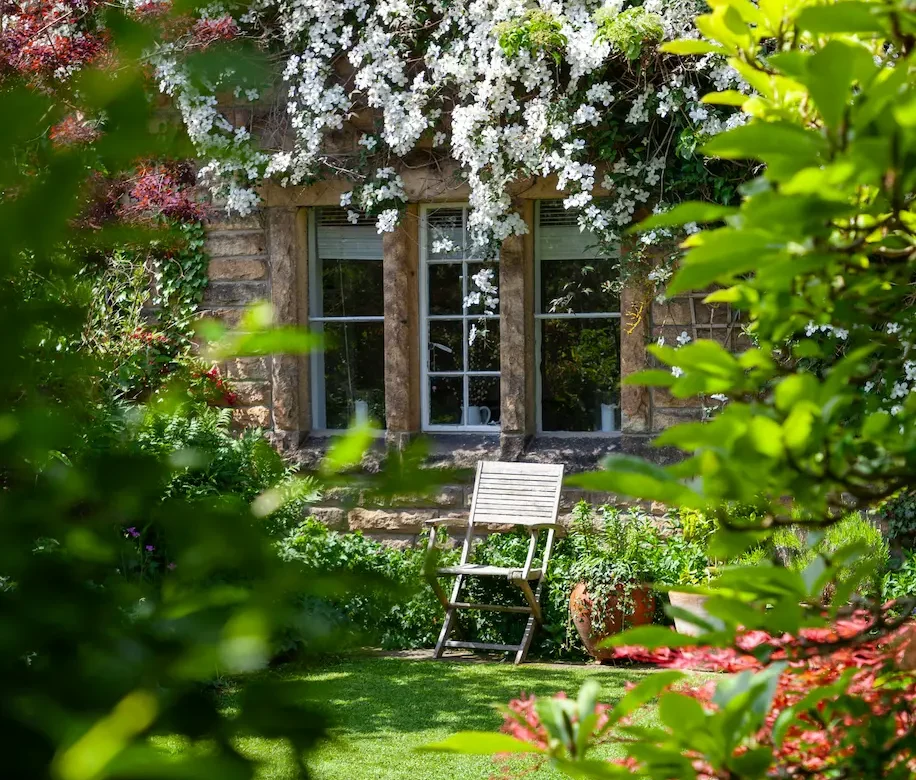
How to create a cottage garden is one of the most searched gardening questions in the UK — and for good reason. How to create a cottage garden taps into something deep in the British relationship with outdoor spaces: the romanticism of tumbling roses, hollyhocks leaning against a stone wall, clouds of sweet peas, and borders so full they seem to overflow onto the path. It’s a style that looks effortless and accidental but is actually built on a set of principles that, once understood, can be applied to any garden, any size, any budget.
The cottage garden is perhaps the most distinctively British contribution to world garden design. It evolved from the working gardens of rural labourers — practical spaces where vegetables, herbs, and flowers grew together in cheerful disorder — and was romanticised by artists and garden writers in the late Victorian era, particularly by Gertrude Jekyll and William Robinson, who elevated the style into something celebrated worldwide. Today it remains the most popular garden style in Britain, from Cotswold villages to suburban semis in the West Midlands.
What Actually Defines a Cottage Garden
Before getting into how to create one, it’s worth being clear about what makes a cottage garden different from other planting styles — because “lots of flowers” isn’t quite the whole picture.
Abundance and informality are the defining characteristics. A cottage garden should look full to overflowing, with plants spilling over edges, self-seeding into paths, and growing in a way that feels natural rather than controlled. Precise, evenly spaced planting is the opposite of what you’re after.
A mix of plants is essential. Traditional cottage gardens combined vegetables, herbs, fruit, and flowers without a strict separation between productive and ornamental. A rose growing next to a row of sweet peas next to some parsley is entirely authentic.
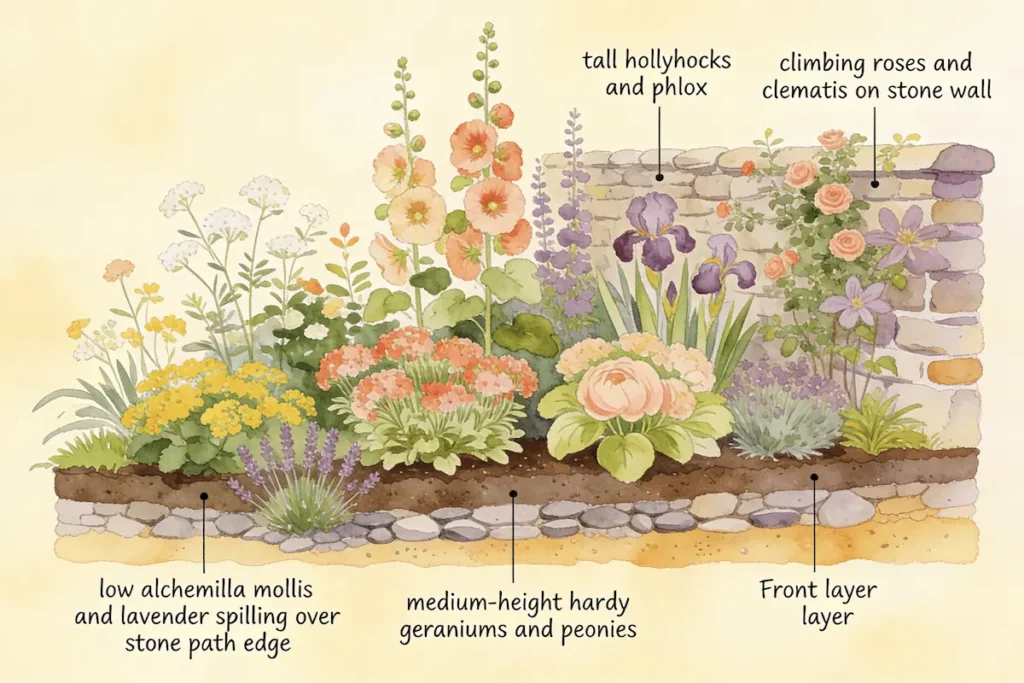
Vertical layers give the style its characteristic lushness. Climbing roses and clematis on walls and arches, tall perennials and hollyhocks at the back, medium-height perennials in the middle, and low-growing plants tumbling over the path edge create that layered, romantic effect.
A limited, harmonious colour palette is what prevents cottage gardens from looking chaotic rather than abundant. The most successful examples work predominantly in soft pinks, purples, whites, and blues, with occasional warm accents of apricot, yellow, or deep crimson. Avoid harsh, saturated oranges and reds in large quantities — they fight with the soft tones that give the style its dreamy quality.
Scent is non-negotiable. A cottage garden without fragrance is missing half its soul. Roses, sweet peas, lavender, stocks, phlox, and pinks (dianthus) should all feature.
The Essential Cottage Garden Plants
Certain plants are so associated with the cottage garden style that they’ve become almost synonymous with it. Not all of these need to be in your garden, but choosing from this palette ensures an authentic feel.
Roses are the cornerstone of any serious cottage garden. Old-fashioned shrub roses — David Austin English roses in particular — have the full, cupped flowers, strong fragrance, and soft colours that suit the style perfectly. ‘Gertrude Jekyll’ (deep pink, extraordinary scent), ‘Crocus Rose’ (apricot-cream), and ‘Munstead Wood’ (deep crimson-purple) are all reliable performers in UK gardens.
Sweet peas climbing a wigwam or trellis are a summer essential — fast-growing, gloriously scented, and exactly the right style. Cut them regularly and they’ll flower from June to August.
Hollyhocks (Alcea) add height and a genuine period feel. The tall, single-flowered forms look more authentic than the doubled pompom types. They’re technically biennials — sow in summer one year to flower the next — and they self-seed prolifically once established.
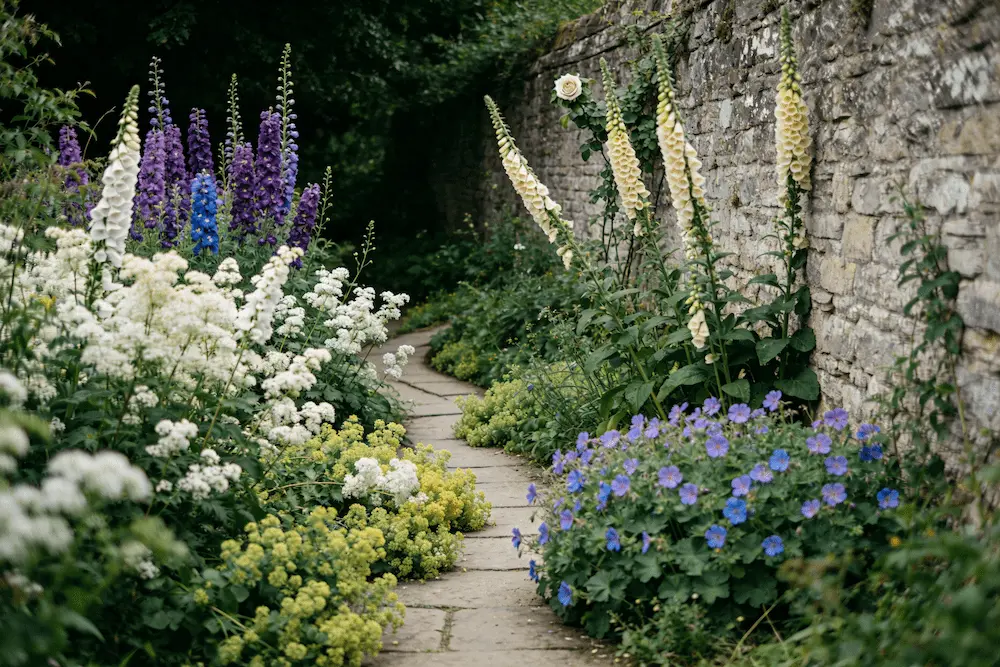
Delphiniums provide the vertical blue spires that are so characteristic of high-summer cottage borders. They need staking but the effect is worth it.
Foxgloves (Digitalis) are another biennial that self-seeds freely in cottage conditions. The native purple foxglove is beautiful, but the pale cream ‘Camelot’ and apricot ‘Sutton’s Apricot’ are refined alternatives.
Geraniums — the hardy perennial kind, not bedding pelargoniums — are the workhorse of the cottage border. They spread to fill gaps, flower for weeks, and tolerate almost any condition. ‘Johnson’s Blue’, ‘Rozanne’, and the magenta ‘Ann Folkard’ are all excellent.
Lavender edging a path is one of the most evocative cottage garden images. It needs good drainage and full sun and should be clipped hard after flowering to keep it compact.
Alchemilla mollis spills over every path edge in every successful cottage garden in Britain. Its frothy lime-green flowers and water-repelling leaves are among the most versatile elements in the style.
Peonies, phlox, achillea, astrantia, aquilegia, campanula, and veronicastrum all belong. So do evening primrose (which self-seeds magnificently), thalictrum for airy height, and echinacea for late summer colour.
📖 Also read: How to Grow Roses in the UK
Structure: The Secret Behind the Apparent Disorder
The paradox of a successful cottage garden is that the apparent disorder is entirely deliberate. Without some underlying structure, a cottage garden tips from abundant into chaotic. The structure can be light — it doesn’t need to be formal — but it needs to be there.
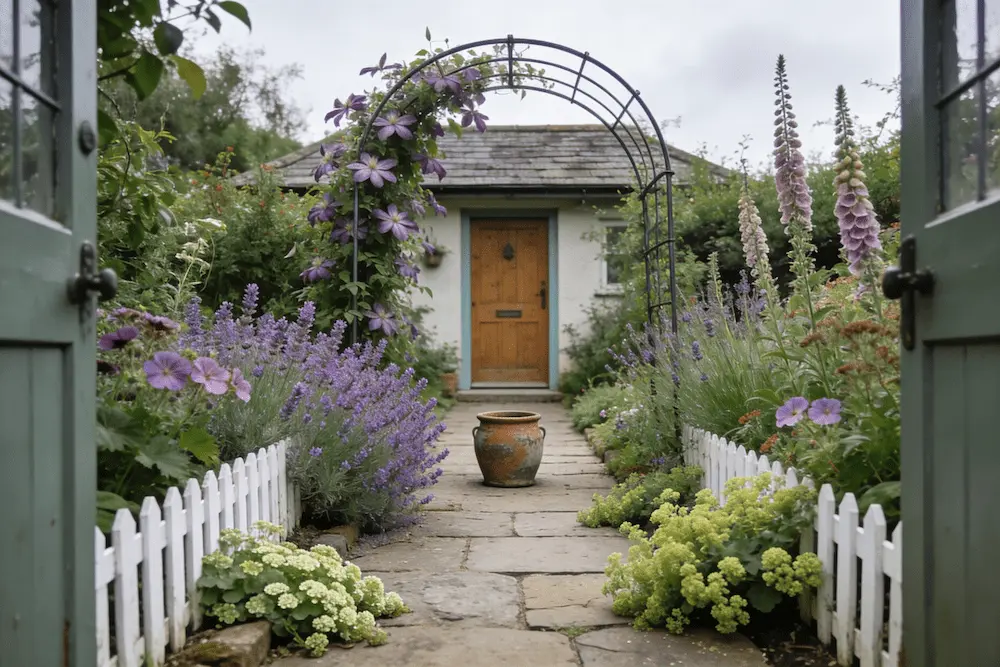
Paths are the most important structural element. Even a simple winding grass path or a line of stepping stones through the planting creates order and gives the eye somewhere to rest. Paths also make the garden accessible for maintenance without trampling plants.
An arch or two instantly signals cottage garden. A simple metal or timber arch covered with a rose or clematis frames a view, creates a journey through the space, and adds vertical interest. In a small garden, a single arch can be the defining feature.
A low boundary — a picket fence, a low wall, a clipped box hedge — frames the planting and gives it a sense of enclosure. The classic cottage garden image has a full, informal border seen against a backdrop that contains it: a stone wall, a fence, a clipped yew hedge.
Focal points prevent the eye from being overwhelmed. A seat at the end of a path, a terracotta pot, a simple sundial — even a single large rose in a key position — gives the planting somewhere to anchor. Without focal points, even a beautiful cottage border can feel restless.
The RHS has excellent guidance on cottage garden planting if you want to explore the historical background and more detailed plant lists.
📖 Also read: How to Layer Plants in a Border
Soil Preparation and Planting
Cottage garden plants are generally not demanding — many actually prefer lean, well-drained soil over rich, heavily fed conditions. Lavender, achillea, and echinacea all perform better in soil that hasn’t been over-improved. Roses and peonies are the exceptions — they appreciate a richer soil with plenty of organic matter.
Before planting a new cottage border, clear weeds thoroughly. Perennial weeds like bindweed and couch grass will be nearly impossible to remove once the border is planted, so take time at this stage. Dig over the border, incorporate some well-rotted compost, and rake level.
Plant in odd-numbered drifts — threes and fives — rather than individual specimens for most perennials. A single plant looks isolated; three plants of the same variety create a drift that reads as intentional and generous. The exception is feature plants like roses and large shrubs, which work as individuals.
Leave generous spacing between plants at planting time — they’ll fill in over the first season. Resist the urge to fill every gap with annuals in the first year; give the perennials room to establish.
Cottage Gardening in a Small Space
One of the great virtues of the cottage garden style is that it scales beautifully downward. A tiny front garden, a narrow side passage, even a collection of pots on a patio can carry a convincing cottage garden feel if the right plants and principles are applied.
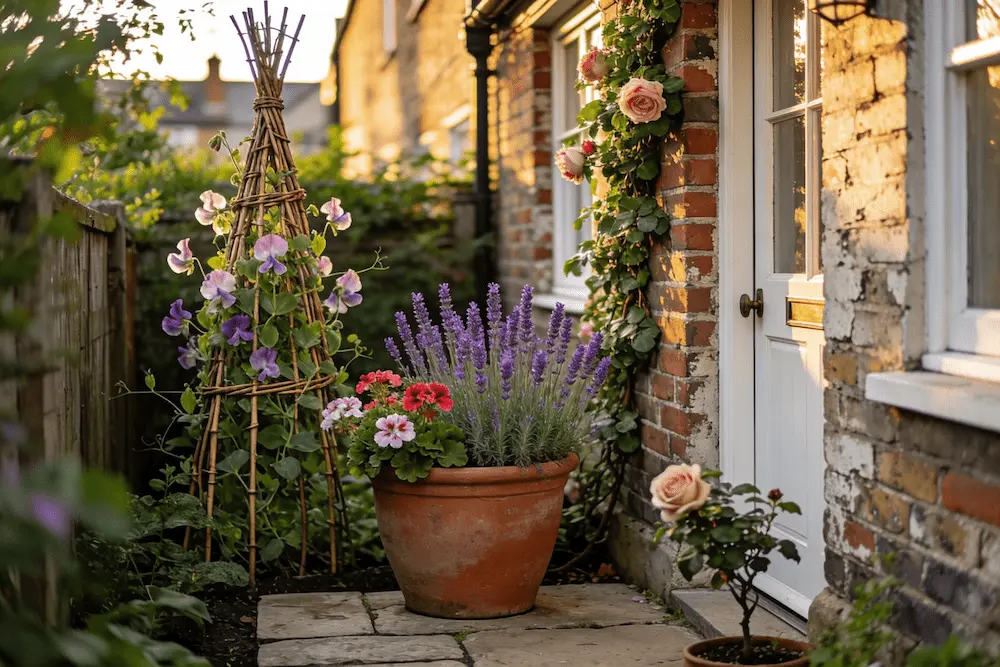
In a small space, maximise vertical planting — roses up the house wall, sweet peas on a wigwam, clematis on a trellis. This creates height and abundance without taking up ground space. A few large pots planted densely with a mix of cottage plants — lavender, geraniums, a small rose, sweet peas — can achieve the overflow effect on a balcony or small patio.
Choose compact varieties specifically: ‘The Fairy’ is a small, repeat-flowering rose perfect for pots and small borders. Dwarf delphiniums, compact aquilegias, and miniature sweet peas are all available and well-suited to smaller gardens.
In a small front garden, a simple design — a central path with a single arch, one deep border on each side, a rose and two lavenders per side, filled in with self-seeding annuals and geraniums — costs relatively little and creates a genuinely beautiful cottage effect that improves year on year as plants establish and self-seed.
📖 Also read: Container Gardening Ideas for Small UK Gardens
Maintenance: Less Than You Think
The cottage garden has a reputation for high maintenance that it doesn’t entirely deserve. Yes, it requires more attention than a lawn-and-shrubs garden. But compared to a formal garden with clipped hedges and precise edging, it’s relatively forgiving — the informal style means small imperfections are part of the aesthetic rather than a problem.
The key tasks are: deadheading regularly through summer to extend flowering, cutting back spent perennials in autumn (or leaving seedheads for winter interest and wildlife), dividing established clumps every three or four years to maintain vigour, and editing out plants that aren’t working while encouraging those that are.
Self-seeding is your friend in a cottage garden. Allow foxgloves, aquilegias, verbena bonariensis, and nigella to self-seed freely — they’ll pop up in unexpected spots and create the naturally planted effect that characterises the style. Just remove unwanted seedlings before they get established rather than letting everything self-seed without control.
Starting Small
If the whole cottage garden picture feels overwhelming, start with just one border. Choose a sunny fence or wall, prepare the soil, and plant it with three roses, a lavender edging, a clematis on the fence, and a mix of five or six hardy perennials from the list above. Add sweet pea seeds in spring. Let it run.
By the second year, you’ll have the beginnings of something genuinely beautiful — and a clear sense of what you want to add, remove, or extend. The cottage garden is not a project you finish; it’s one you keep shaping season by season, which is part of what makes it so endlessly satisfying.
Leave a Reply