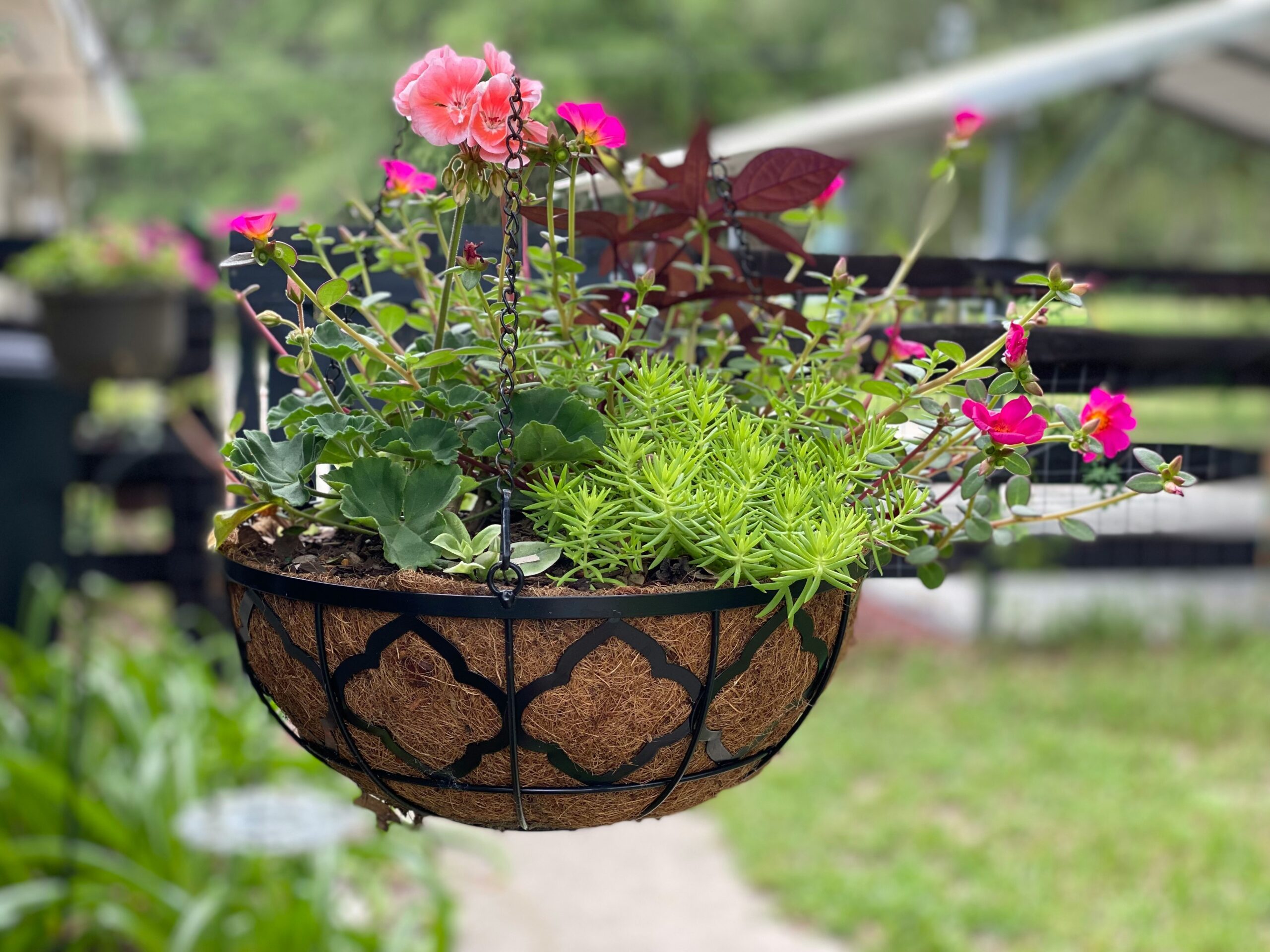
Hanging flower baskets in the UK are one of the most visible and instantly rewarding ways to add colour to a garden, doorstep, or patio — and one of the most frequently got wrong. A basket that looks spectacular in late May and is a brown tangle of dead stems by late July is a very common British experience, and it’s almost always the result of the same small number of fixable mistakes. Getting hanging flower baskets right in the UK comes down to understanding what the plants inside them actually need, which is more water and more feed than most people provide, and less complication than most planting guides suggest.
This guide covers everything: choosing plants, planting up, the watering and feeding regime that keeps baskets looking good through September, and the most common reasons they fail.
Choosing the Right Plants for UK Hanging Baskets
The UK climate — cool springs, variable summers, reliable autumn rain — suits some hanging basket plants far better than others. Choosing varieties bred or selected for cool, damp conditions rather than hot Mediterranean summers makes a significant difference.
Trailing lobelia is a British hanging basket staple and for good reason. It tolerates cool, wet summers far better than most tender plants, produces a long season of tiny flowers in blue, white, or red, and fills the edges of a basket beautifully. It does flag in very hot dry spells but recovers quickly with water.
Fuchsias are arguably the most reliable hanging basket plant for the UK. Trailing varieties like Trailing Empress of Prussia, Marinka, and Golden Marinka are specifically bred for basket use, produce flowers continuously from May to October, actually prefer the cooler, moister conditions of a British summer, and recover dramatically well from neglect as long as they’re watered before they completely desiccate.
Petunias — particularly the Surfinia and Tumbelina series developed for UK conditions — are excellent basket plants for sunnier positions. They produce masses of flowers, trail generously over basket edges, and are more rain-tolerant than older petunia varieties. Avoid growing them in deeply shaded positions where they become leggy and reluctant to flower.
Calibrachoa (million bells) produces tiny petunia-like flowers in enormous quantities on naturally trailing stems. They’re more compact than Surfinias, excellent for the sides and edges of baskets, and available in a huge range of colours. They’re slightly less tolerant of cold and wet than fuchsias or lobelia but perform very well in a reasonable UK summer.
Bacopa is an underrated basket plant that produces small white or pink flowers continuously and trails beautifully. It’s particularly useful as a filler between showier plants and tolerates rain and cooler temperatures well.
Begonias — specifically trailing tuberous begonias and the Illumination series — are outstanding for shaded positions where other basket plants struggle. They flower prolifically in conditions that would stop petunias and lobelias, making them the best choice for a north-facing doorstep or a shaded porch.
Ivy-leaved pelargoniums (trailing geraniums) are superb in sunny, sheltered positions. They’re more drought-tolerant than most basket plants, which is useful during holiday periods, but they don’t recover well from heavy rain that causes petal drop. Best suited to sheltered, sunny spots in southern England.
Planting Up a Hanging Basket
When to plant: in the UK, plant up hanging baskets from mid-April to late May. If planting before mid-May, keep the basket in a frost-free greenhouse or porch until risk of frost has passed — tender plants like fuchsias, petunias, and calibrachoa will be killed by a late frost.
The basket: wire baskets lined with coir, sphagnum moss, or a pre-formed liner give the best results for side planting and allow for excellent drainage. Solid plastic baskets with a built-in water reservoir at the base reduce watering frequency and are more forgiving for beginners — the reservoir provides a buffer against the rapid drying that catches people out.
Compost: use a peat-free multipurpose compost with a slow-release fertiliser granule added at the recommended rate. The fertiliser granules release nutrients over three to four months, providing a baseline of feeding that supports continuous flowering even if liquid feeding is occasionally missed.
Planting density: good hanging baskets look full and generous from day one. Use more plants than seems necessary — a standard 35–40cm basket typically takes five to seven plants in the top plus three to four plants pushed through the sides (for wire baskets). Crowded plants compete slightly for space, which actually encourages outward and downward trailing growth rather than upward leafy growth.
To plant the sides of a wire basket, line the bottom third with your liner material, push trailing plants through from the outside with roots pointing inward, then continue building up the liner and filling with compost around the root balls. Water thoroughly after planting and before hanging.
Positioning Your Baskets
Most hanging basket plants need at least four to five hours of direct sun daily for the best flowering. A south or west-facing wall or doorstep is ideal for sun-lovers like petunias and pelargoniums.
For shaded north or east-facing positions, stick to fuchsias, begonias, and bacopa — these will flower well in partial shade where petunias and calibrachoa would become drawn and reluctant.
Height matters practically: hang baskets high enough that they’re visually appealing but low enough that you can reach them comfortably to water. A basket hung too high is a basket that doesn’t get watered regularly enough — and irregular watering is the primary cause of basket failure.
Consider the wind exposure of your position. Hanging baskets in exposed, windy spots dry out dramatically faster than sheltered ones and are prone to physical damage in summer storms. A sheltered corner of the house, a porch, or a position near a wall that breaks the wind significantly extends basket life and reduces watering demands.
Watering — The Most Important Thing
This is where most hanging basket failures in the UK begin. Baskets in full summer growth and flowering need far more water than most people give them — in warm weather, a fully planted basket may need watering once or twice daily.
The compost in a hanging basket dries out dramatically faster than in a border or pot on the ground, because it’s exposed to air movement on all sides, in full sun, and contains a large number of plants transpiring simultaneously. A basket that feels light when lifted and has dry compost 2cm below the surface needs water immediately.
Water until it runs freely from the base of the basket — a light splash that dampens only the surface does more harm than good, as it encourages roots to stay near the surface where they’re even more vulnerable to drying out. In very hot weather, watering in the evening prevents rapid evaporation and gives plants the overnight period to absorb moisture.
If a basket has dried out completely and the compost has shrunk from the sides, place the whole basket in a bucket of water for twenty minutes to allow the compost to rehydrate fully. Watering from the top of a severely dried basket simply runs down the gap between compost and basket sides without penetrating.
A drip irrigation system connected to an outdoor tap, with a timer, transforms the summer basket experience for anyone who finds daily watering difficult — particularly during holidays. Basic systems are inexpensive and widely available from UK garden centres and online.
📖 Also read: Container Gardening Ideas for Small UK Gardens — How to Grow a Lot in Very Little Space
Feeding — The Second Most Important Thing
Slow-release fertiliser granules added at planting provide a baseline, but they’re not enough on their own for baskets in full summer flower. The watering regime that keeps baskets healthy also washes nutrients out of the compost rapidly, and a basket that isn’t being fed supplementally will run short of nutrients by July.
From about four weeks after planting, feed every week with a high-potassium liquid fertiliser — tomato feed is ideal and widely available. Apply at the recommended rate, replacing one of the regular waterings rather than in addition to it.
The difference between a fed and an unfed basket becomes visible by August. A well-fed basket in late August looks almost as good as it did in June — dense, full of flowers, continuing to produce new buds. An unfed basket in the same period looks tired, produces fewer flowers, and the foliage takes on a slightly pale, yellowed tone.
Deadheading — removing spent flowers before they set seed — complements feeding by keeping the plant focused on producing new flowers rather than seed. For lobelia and calibrachoa it’s impractical (too many tiny flowers), but for fuchsias, petunias, and begonias, five minutes of deadheading every few days through July and August makes a visible difference to flower density.
Common Problems
Basket drying out despite regular watering usually means the compost has hydrophobically dried — it’s become water-repellent after severe desiccation. The bucket-soaking method described above is the fix. Going forward, a water-retaining gel added to the compost at planting (water-retaining crystals or granules) helps prevent the problem recurring.
Plants becoming leggy and producing few flowers indicates insufficient light, insufficient feeding, or both. Review the basket’s position — has a nearby plant or structure begun shading it since planting? Increase feeding immediately.
Fuchsia gall mite has become a significant problem in UK gardens in recent years. It causes grotesquely distorted new growth — twisted, discoloured, hairy-looking shoot tips — and has no effective organic treatment. Remove and dispose of affected growth, and consider replacing badly affected plants with a resistant variety. The RHS maintains an updated list of resistant fuchsia varieties as the situation with this relatively new pest continues to develop.
Vine weevil — the distinctive notched leaf margins are the giveaway — affects many basket plants, with the grubs feeding on roots unseen. Nematode biological controls watered into baskets in late summer are effective.
Yellowing leaves on otherwise healthy-looking plants usually indicate nutrient deficiency from insufficient feeding. Increase liquid feeding frequency and the colour should return within two weeks.
📖 Also read: Why Are My Plant Leaves Turning Yellow? (10 Real Causes and How to Fix Each One)
Overwintering Basket Plants
Several hanging basket plants are worth saving over winter rather than discarding.
Fuchsias are the most worth keeping. Cut back by half in October, bring into a frost-free but cool location (an unheated garage, shed, or greenhouse), water sparingly through winter, and bring back into growth in March. An overwintered fuchsia becomes a significantly larger, more productive plant the following year.
Pelargoniums can be overwintered similarly — cut back, brought in before frost, kept barely moist in a cool frost-free space. They’re more forgiving of slightly warmer storage conditions than fuchsias.
Tuberous begonias should have their tubers lifted in October, dried, and stored in paper bags or boxes of dry compost in a frost-free location. Restart in pots indoors in March.
Most other basket plants — lobelia, petunias, calibrachoa, bacopa — are best treated as annuals and composted at the end of the season, buying fresh plants or raising from seed the following spring.
A Few Final Thoughts
A well-planted, well-watered, well-fed hanging basket in a UK summer is genuinely one of the most impactful things you can do for the appearance of a house front, a patio, or a garden entrance. The effort is concentrated in the first two weeks — getting the planting right and establishing the watering habit — and from there it’s mainly maintenance.
The difference between a basket that struggles and one that thrives is almost never the plants themselves. It’s almost always the watering and feeding. Get those two things consistently right through July and August, and the basket will look after itself for the rest.
Leave a Reply