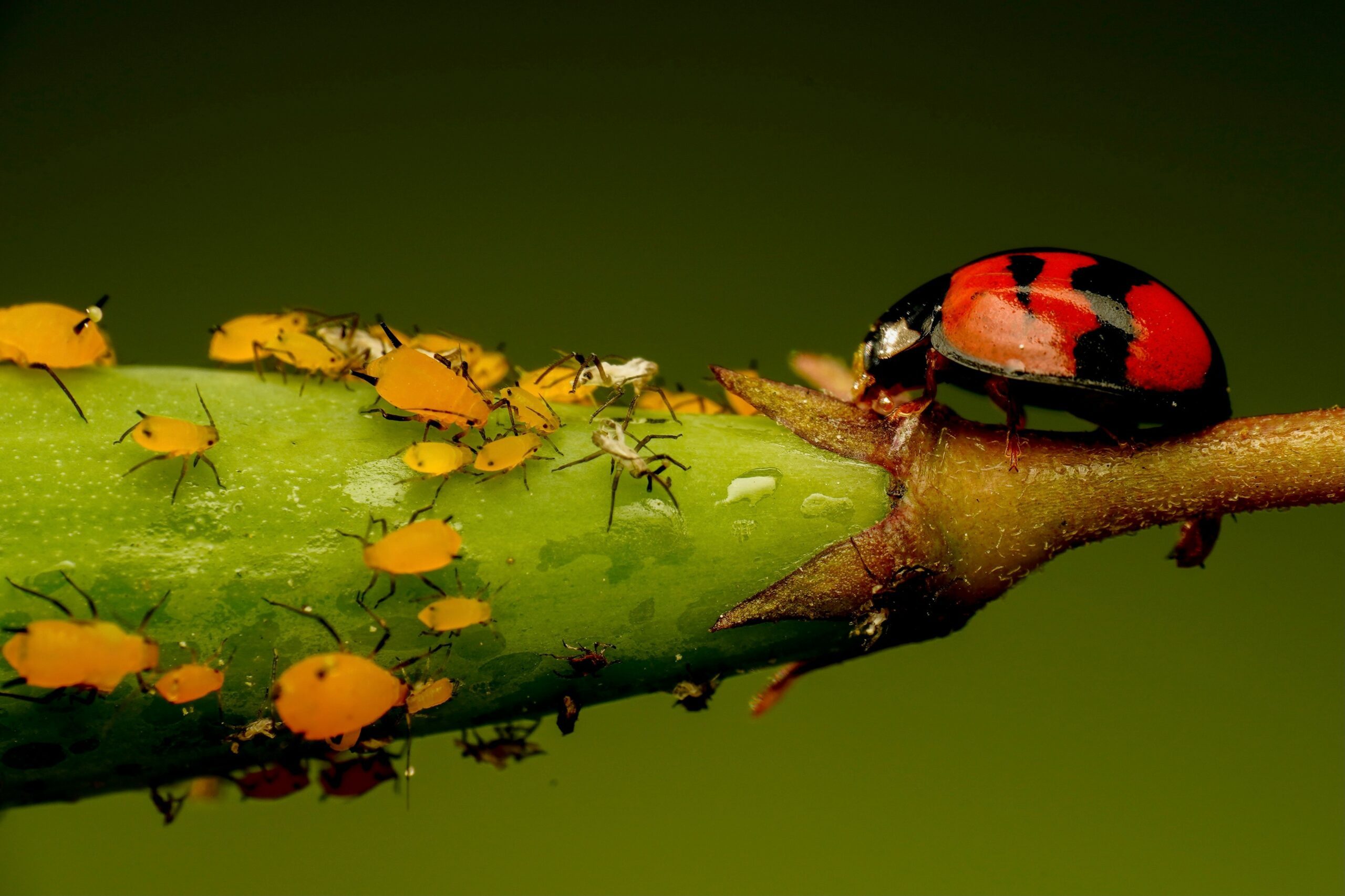
Knowing how to get rid of aphids naturally is one of the most useful things a UK gardener can learn, because aphids are one of the most inevitable. Every garden in Britain will have them at some point — the blackfly colonising the tops of broad beans in May, the greenfly clustering on rose buds in June, the woolly aphids coating apple branches in July. How to get rid of aphids naturally, without reaching for a chemical spray, is both more achievable than most people assume and far more sustainable in the long run.
The good news is that aphids, despite their numbers, are genuinely vulnerable to a wide range of natural controls. The bad news is that chemical sprays — even the ones marketed as safe — tend to kill those natural controls along with the aphids, leaving you locked into a cycle of spraying that makes the problem worse over time. Breaking that cycle and working with the garden’s own biology is the most effective long-term strategy, and this guide explains exactly how to do it.
Understanding Aphids: Why They’re Such a Problem in the UK
Aphids are small, soft-bodied insects — usually 1–3mm long — that feed by inserting needle-like mouthparts into plant tissue and sucking out sap. A single aphid causes minimal damage. The problem is that they reproduce astonishingly fast: a single female can produce up to 80 offspring per week without mating, and in warm UK summers those offspring are reproducing within days of birth.
A colony that goes unnoticed for a fortnight can number in the thousands. At that density, aphids cause visible damage — distorted, curled leaves, stunted growth, and wilting shoot tips — and excrete a sticky substance called honeydew that coats leaves and encourages the growth of sooty mould, a black fungal coating that reduces the plant’s ability to photosynthesise.
Aphids also transmit plant viruses as they feed, moving from plant to plant and introducing disease that outlasts the aphids themselves. This is why early intervention, even before colonies reach damaging numbers, makes sense.
There are hundreds of aphid species in the UK, with different species specialising on different host plants. This specificity is useful to know: the blackfly on your broad beans is a different species to the greenfly on your roses, and neither will transfer to your courgettes. Each infestation is largely self-contained.
How to Get Rid of Aphids Naturally: Start with Your Hands
The simplest, fastest, and most effective immediate control for aphids is physical removal — and it works better than most people expect.
Squashing by hand is straightforward for small colonies on accessible plants. Run your fingers along affected stems and shoot tips, squashing clusters between thumb and forefinger. It’s not glamorous, but it’s immediate, free, and doesn’t harm anything else in the garden.
Blasting with water is highly effective for larger infestations. A firm jet from a hose or a hand sprayer knocks aphids off the plant and onto the soil, where most of them are unable to return. The key detail is to target the undersides of leaves and the growing tips where aphids congregate, and to repeat every two to three days until the colony is under control. One blast doesn’t finish the job, but three or four over a week usually does.
For more delicate plants where a strong water jet might cause damage, a hand-held plant mister on its strongest setting works well.
Encouraging Natural Predators
This is the most powerful long-term strategy for aphid control in a UK garden, and it costs nothing beyond planting the right things and resisting the urge to spray.
Ladybirds are the most famous aphid predator, and both adults and larvae eat them voraciously. A single ladybird larva — the black and orange spiky creature that many gardeners mistake for a pest — can consume up to 200 aphids per day. The 7-spot ladybird is the most common UK species; the harlequin ladybird, introduced from Asia, is now widespread and equally useful for aphid control despite its controversial ecological reputation.
Ladybirds overwinter in sheltered spots — hollow plant stems, leaf litter, crevices in bark — and emerge in spring just as aphid populations begin to build. Leaving some garden tidying until spring rather than doing it all in autumn helps ladybird populations overwinter successfully.
Lacewings are less well-known but arguably even more effective than ladybirds. The larvae are voracious aphid predators, and the lacy-winged adults are attracted to gardens with shelter and a reliable food source. Lacewing hotels — bundles of hollow stems or cardboard tubes in a sheltered spot — encourage them to overwinter in your garden.
Hoverflies look like small wasps but are harmless flies whose larvae are excellent aphid predators. Adult hoverflies feed on nectar and pollen, so planting flat, open flowers — phacelia, marigolds, umbellifer family plants like fennel and dill — attracts them to your garden and keeps them there.
Blue tits and other small birds eat large quantities of aphids, particularly when feeding young in spring. A garden with nest boxes, hedges for shelter, and no pesticide use will have significantly more bird activity than one without.
📖 Also read: How to Create a Wildlife-Friendly Garden — The UK Beginner’s Guide to Gardening with Nature
Companion Planting for Aphid Control
Certain plants either repel aphids or attract their predators, and strategic planting can significantly reduce aphid pressure across the whole garden.
Marigolds (Tagetes) are one of the most widely used companion plants in UK kitchen gardens. Their scent confuses and deters aphids, and their open flowers attract hoverflies. Planted between rows of vegetables or alongside roses, they provide low-level protection throughout the growing season.
Nasturtiums work as an aphid trap plant — aphids find them irresistible and will colonise a nasturtium in preference to almost any nearby plant. Used deliberately as a sacrificial crop, nasturtiums draw aphids away from more valuable plants and concentrate them in one place where they can be dealt with easily.
Alliums — garlic, chives, and ornamental alliums — have a reputation for deterring aphids when planted near roses and other susceptible plants. The evidence for this is anecdotal rather than rigorously scientific, but many experienced UK gardeners swear by interplanting roses with chives, and the chives look good in the border regardless.
Fennel, dill, and other umbellifers attract parasitic wasps and hoverflies that prey on aphids. Including a few of these in or near the vegetable garden creates a hospitable environment for aphid predators throughout the season.
📖 Also read: Plant These Next to Your Tomatoes and Watch What Happens (UK Companion Planting Guide)
Natural Sprays That Work
When physical removal and biological controls aren’t enough — particularly for a heavy infestation on a vulnerable plant — several natural sprays are effective against aphids without the broader environmental impact of synthetic insecticides.
Insecticidal soap spray is the most reliable natural aphid treatment available. It works by dissolving the waxy coating on an aphid’s body, causing dehydration. You can buy ready-made formulations from any UK garden centre, or make your own by dissolving a small amount of pure liquid soap (not washing-up liquid, which can damage plants) in water. Spray directly onto aphid colonies, covering both sides of leaves. It breaks down quickly and leaves no harmful residue, though it also kills on contact rather than systemically, so good coverage is essential.
Neem oil is derived from the seeds of the neem tree and acts as both a repellent and a growth disruptor for insects. It’s particularly useful for persistent infestations and as a preventative spray applied before colonies establish. It’s safe for mammals and birds but can affect aquatic invertebrates, so avoid spraying near ponds.
Garlic spray — made by steeping crushed garlic in water overnight and straining — has a reasonable evidence base as an aphid deterrent, particularly on roses. It needs reapplying after rain and is more useful as a preventative than a treatment for established colonies.
All natural sprays are most effective applied in the early morning or evening, avoiding the hottest part of the day when plants are more susceptible to spray damage.
Dealing with Specific Aphid Problems in the UK
Blackfly on broad beans is one of the most common aphid problems in UK kitchen gardens and arrives with reliable timing every May. The best prevention is to pinch out the growing tips of broad bean plants once the first flower trusses have set — this removes the soft new growth that blackfly target and, as a bonus, reduces the risk of chocolate spot disease. Any colonies that establish despite this can be dealt with by hand-squashing or a soap spray.
Greenfly on roses is best managed by encouraging ladybird populations and checking plants weekly from April onwards. Early colonies spotted and squashed before they build are far easier to deal with than large established ones. Avoid high-nitrogen feeds on roses in spring, which produce the soft, sappy growth that greenfly find most attractive.
Woolly aphids on apple trees appear as white, waxy deposits on branches and can be persistent. A stiff-bristled brush dipped in methylated spirit, applied directly to the woolly deposits, kills the aphids without harming the tree. Rough bark should be cleaned up to remove overwintering sites in autumn.
Root aphids are harder to detect and treat as they feed underground. Wilting plants in the absence of obvious above-ground causes can indicate root aphids. Drenching the soil around affected plants with an insecticidal soap solution is the most practical natural treatment.
What Not to Do
Don’t spray indiscriminately. Even organic and natural sprays kill aphid predators if they make contact. Spot-treat colonies rather than spraying whole plants or beds.
Don’t panic at the first sign of aphids. A small colony on a healthy plant will often be dealt with by natural predators before it causes significant damage — particularly in May and June when ladybird and lacewing populations are ramping up. Intervention is warranted when colonies are dense, growing rapidly, or causing visible plant damage.
Don’t use pyrethrum or pyrethroid-based sprays as an “organic” alternative — these are derived from natural sources but are highly toxic to beneficial insects, aquatic invertebrates, and honeybees. Their ecological impact is comparable to synthetic insecticides.
The RHS provides guidance on controlling aphids without chemicals and maintains an up-to-date list of approved treatments, which is worth checking before purchasing any commercial product.
📖 Also read: 10 Plants That Slugs Actually Hate (And Why Gardeners in the UK Need to Know This)
A Few Final Thoughts
Aphids are a permanent feature of British gardens, not a problem to be solved once and forgotten. The goal isn’t eradication — it’s balance. A garden with enough biodiversity, enough predator habitat, and enough restraint about chemical use will reach a natural equilibrium where aphid populations stay manageable without constant intervention.
That equilibrium takes a season or two to establish, and there will be moments along the way where intervention is needed. But a garden that’s genuinely working as an ecosystem — with ladybirds, lacewings, hoverflies, and birds all doing their part — is a more resilient, more interesting, and ultimately more productive place than one kept sterile with sprays.
Work with the biology, not against it. The results, over time, are reliably better.
Leave a Reply