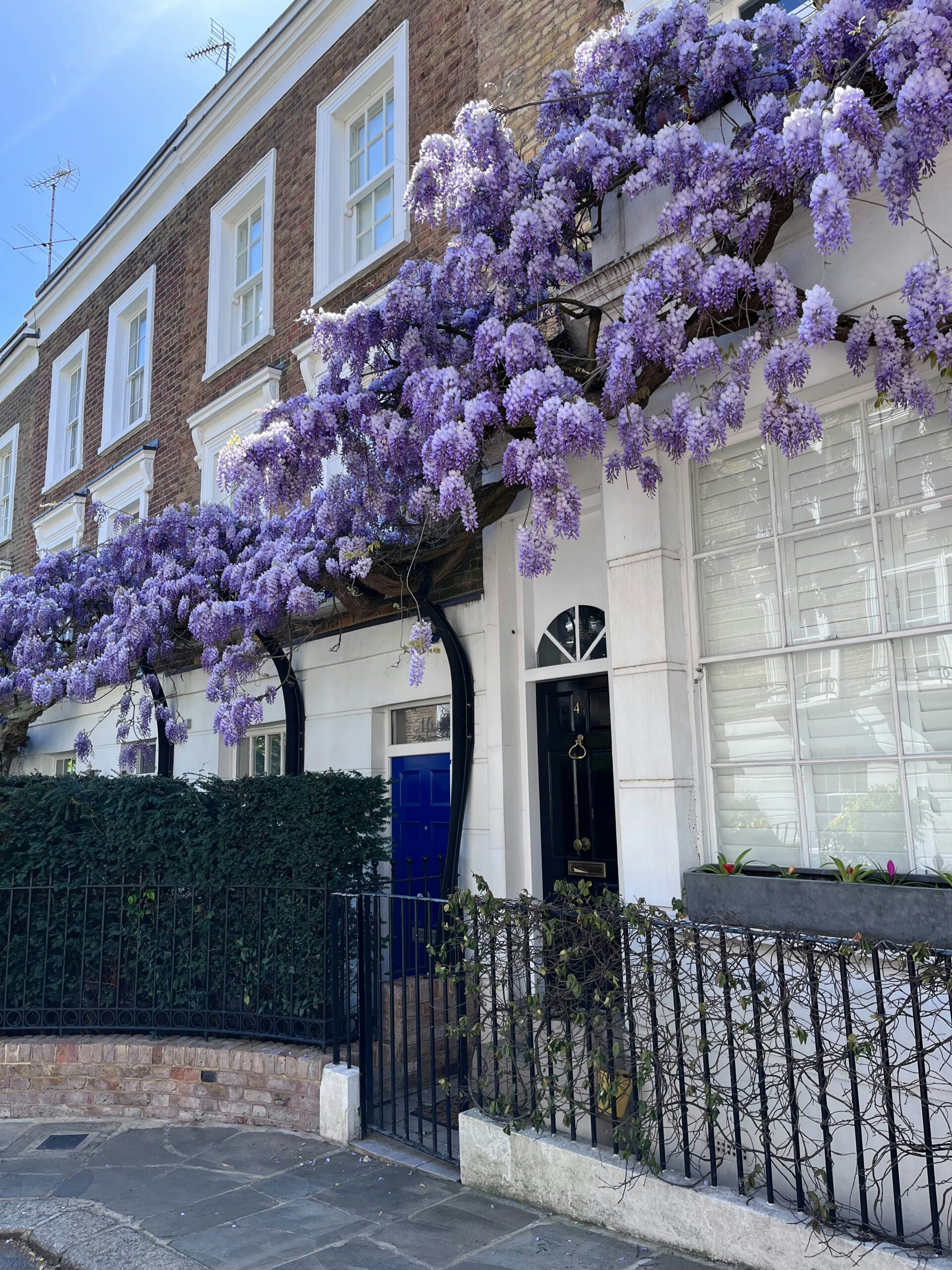
Few plants stop people in their tracks quite like a wisteria in full bloom. Learning how to grow wisteria in the UK is one of those gardening ambitions that many people carry for years before acting on — partly because the plant has a reputation for difficulty, and partly because the results, when they work, are so extraordinary that failure feels unthinkable. How to grow wisteria in the UK is genuinely achievable for beginners, but it does require understanding a few things about this plant that most advice glosses over: why it sometimes refuses to flower, how to prune it correctly, and why buying the right plant in the first place makes everything else easier.
Get those things right and wisteria is one of the most magnificent plants a British garden can hold — a cascade of violet, white, or pink flowers in May, a curtain of fresh green foliage through summer, and a sculptural tracery of stems through winter that has its own quiet beauty.
Choosing a Wisteria: The Decision That Changes Everything
The most important decision you’ll make about wisteria happens before you plant anything, in the garden centre or online nursery. It determines whether you’re waiting three years for flowers or potentially fifteen.
Buy a grafted plant, not a seedling. Wisterias grown from seed can take ten to twenty years to flower, and there’s no guarantee they’ll be worth waiting for. Grafted plants — where a named variety has been joined onto a rootstock — flower within three to five years of planting and reliably reproduce the qualities of the parent. The graft union is visible as a slight swelling or kink near the base of the main stem. If you can’t see a graft union and the label doesn’t describe it as a named variety, don’t buy it.
Japanese wisteria (Wisteria floribunda) produces extremely long flower racemes — some varieties up to 90cm — and flowers slightly later than Chinese types, often into June. Multijuga (also sold as Macrobotrys) is the most famous variety, with racemes that can reach 1.2m in a good year. Royal Purple and Rosea are reliable UK performers.
Chinese wisteria (Wisteria sinensis) is the most commonly grown type in UK gardens. It flowers before the leaves emerge — usually in May — which means the flowers are displayed against bare stems rather than foliage, making the display particularly dramatic. Alba (white) and the standard purple are widely available and reliable. Chinese wisteria twines anticlockwise; Japanese twines clockwise — a detail that matters only if you’re tying it to a support.
Wisteria brachybotrys (silky wisteria) produces shorter but intensely fragrant racemes and is a good choice for smaller gardens or structures that wouldn’t support the weight of a fully mature Chinese or Japanese plant.
Where to Plant Wisteria in the UK
Wisteria needs full sun or very light partial shade. The more sun, the better the flowering — a south or west-facing wall is the classic and correct position. North and east-facing aspects produce poor flowering and are not worth attempting with this plant.
Shelter matters. The flowers emerge in May — prime late frost season in the UK — and a late frost can destroy an entire year’s display. A wall that provides some frost protection, particularly from the east, extends the flowers significantly. In Scotland and northern England, a sheltered south-facing wall isn’t just preferred, it’s effectively essential for reliable flowering.
The support structure needs to be substantial and permanent. A mature wisteria is an extremely heavy plant — the stems become genuinely woody and thick over years, and the weight of foliage and flowers in full growth is considerable. Fence panels, lightweight trellis, and most pergola kits are not adequate for a mature wisteria without additional reinforcement. Horizontal wires fixed to vine eyes in masonry, spaced about 30cm apart, is the most reliable system — it’s strong, adjustable, and allows air to circulate between the plant and the wall.
Space: wisteria needs room. A well-established plant can cover 10 metres or more of wall and reach several metres upward. For smaller gardens or structures, the silky wisteria types or growing as a standard (trained as a small tree) are more suitable options.
How to Grow Wisteria in the UK: Planting
Plant container-grown wisteria in spring or autumn — both work well, though spring is preferable in colder northern gardens as it gives the plant a full growing season to establish before winter.
Dig a generous planting hole — at least 60cm wide and deep — and improve the soil with well-rotted compost or manure. Wisteria is not particularly fussy about soil type and grows in most UK garden soils, including clay, as long as drainage is reasonable. It prefers a slightly neutral to acidic pH and can show signs of nutrient deficiency on very chalky, alkaline soils.
Plant at the same depth as it was growing in the container. Firm in well, water thoroughly, and mulch around the base with compost or bark. Keep the mulch away from the main stem.
Immediately begin training the main stems along the support wires or structure in the direction you want them to go. Wisteria twines naturally, but guiding the young stems early establishes the framework that will support decades of growth. Tie in loosely with soft twine, not wire, which can cut into stems as they thicken.
In the first year, focus entirely on establishment — water regularly in dry spells, and don’t worry about flowers. In the second year, begin the pruning regime that is central to getting wisteria to flower reliably.
Pruning Wisteria: The Key to Reliable Flowering
This is the aspect of wisteria growing that most beginners find confusing, and it’s the most common reason established plants fail to flower. The good news is that once you understand what you’re doing and why, wisteria pruning is straightforward — it just needs to happen twice a year, every year.
Why twice-yearly pruning matters: wisteria flowers are produced on short spurs — stubby, knobbly growths that develop on established wood. Long, whippy new shoots (called leaders or extension growth) produce leaves and extend the plant’s reach but don’t flower. Twice-yearly pruning controls the extension growth and encourages the development of flowering spurs.
Summer pruning (July–August): cut back all the long, whippy new shoots that have grown since spring, reducing them to five or six leaves from the point where they join the main branch. This is done while the plant is in full growth. You’re not removing anything that will flower — you’re controlling the extension and beginning the process of spur development.
Winter pruning (January–February): cut back the same shoots again — the ones you pruned in summer will have continued to grow slightly — reducing them to two or three buds from their base. These short stubs are the developing flower spurs. Over several years of twice-yearly pruning, the framework of spurs builds up and the plant produces increasingly generous flowering.
A wisteria that has never been pruned — or pruned only occasionally — produces masses of growth and few flowers. A wisteria pruned twice a year from year two or three onwards should flower reliably from year four or five.
📖 Also read: The Only Gardening Tools a UK Beginner Actually Needs (And What’s a Waste of Money)
Feeding and Ongoing Care
Wisteria is not a particularly hungry plant and overfeeding — particularly with nitrogen-rich fertilisers — actively discourages flowering by pushing vegetative growth at the expense of flower bud development.
In early spring, a dressing of a high-potassium fertiliser — a tomato feed granule or rose fertiliser — around the base of the plant supports flower bud development. Avoid lawn fertilisers, general-purpose feeds with high nitrogen, and farmyard manure applied directly around the base, all of which push leafy growth.
Water newly planted wisteria regularly through the first two growing seasons. Established plants are remarkably drought-tolerant and rarely need supplementary watering in the UK climate.
An annual mulch of compost or bark around the base suppresses weeds and retains moisture, which is beneficial in the establishment years particularly.
Why Won’t My Wisteria Flower?
This is one of the most common gardening questions in the UK, and the causes are almost always one of the following:
The plant is too young. Even a grafted plant takes three to five years to flower. Patience is required. If your plant is under four years old and was correctly grafted, keep pruning as described and wait.
It’s never been pruned, or only pruned once a year. This is the most common cause of non-flowering in mature plants. Begin the twice-yearly pruning regime immediately — improvement usually appears within two seasons.
The position is too shady. Wisteria needs sun to flower. If the wall or structure it’s growing on doesn’t receive direct sun for most of the day, flowering will be poor regardless of how well everything else is managed.
It was grown from seed. See above — this can mean a very long wait with no guarantee of quality flowers. If you suspect this is the case, the only reliable fix is to replace the plant with a grafted named variety.
Frost damage. A late frost in May — not uncommon in many parts of the UK — can destroy an entire year’s flower buds. The plant itself is unharmed and will flower the following year, but there’s no recovery from frost-damaged buds within the same season. Fleece protection on forecast frost nights in May can save the display in vulnerable positions.
📖 Also read: The Complete UK Gardening Calendar — What to Do in Your Garden Every Month of the Year
Wisteria in Containers and as Standards
For smaller gardens or for gardeners who don’t have a suitable wall, wisteria can be grown in large containers or trained as a standard — a single stem trained upright on a stake with a rounded head of growth at the top.
Container growing requires a large pot (at least 60cm diameter), very well-drained compost, consistent feeding with a high-potassium fertiliser, and regular repotting every two to three years. Container plants need more water and attention than those in the ground but can be spectacular on a patio or terrace.
Standards are created by training a single stem upright on a sturdy stake, removing all side shoots until the desired height is reached, then allowing the head to develop and branching to occur from that point. The same twice-yearly pruning regime applies to maintain the spur system in the head of the standard.
Both methods produce wisterias that flower reliably with the correct management, and both are far more suitable for a small modern British garden than planting against a wall and hoping for the best.
Leave a Reply