The plants that thrive in a shady north-facing UK garden are not a compromise — they’re a different kind of opportunity. If you have a north-facing garden, a shaded courtyard, or a border that barely sees direct sun, the instinct is to fight it: to try the sun-loving plants that look spectacular in other people’s gardens and watch them fail year after year. The plants that thrive in shady north-facing UK gardens are genuinely beautiful in their own right, and a well-planted shady garden has a quality that a sun-baked south-facing plot simply can’t replicate — a cool, lush, almost woodland atmosphere that feels like a different world in July.
This guide covers ten plants that don’t just tolerate shade but genuinely perform in it, chosen for reliability in UK conditions, year-round interest, and availability in British nurseries and garden centres.
Understanding Your Shade
Before choosing plants, it’s worth being specific about what kind of shade you’re dealing with — because not all shade is the same, and it significantly affects what will grow.
Deep shade — the dry, dark ground beneath dense evergreen trees, or a narrow courtyard surrounded by tall walls on all sides — receives virtually no direct light and is the most challenging condition of all. Even shade-loving plants struggle here.
Partial shade — a north-facing border that gets a couple of hours of direct sun in midsummer, or a spot that receives bright indirect light throughout the day — is far more manageable and suits a wide range of plants.
Damp shade — a north-facing bed with reasonable moisture retention — is actually one of the most plant-friendly conditions in the UK. Many of the most beautiful woodland plants thrive exactly here.
Dry shade — beneath trees, next to buildings where walls intercept rainfall, or against fences — is genuinely difficult. The plants in this guide are chosen partly because several of them handle dry shade as well as damp, which covers the most common north-facing garden scenarios in the UK.
1. Ferns
Ferns are the definitive shade garden plants and some of the most beautiful foliage plants in the British flora. For a north-facing UK garden, the native hart’s tongue fern (Asplenium scolopendrium) — with its glossy, undivided strap-like fronds — is outstanding in dry or damp shade and is almost indestructible once established. The soft shield fern (Polystichum setiferum) produces elegant, finely divided fronds that persist through winter and look spectacular from spring through autumn.
For something more dramatic, the Japanese painted fern (Athyrium niponicum var. pictum) produces silvery, burgundy-flushed fronds that bring genuine colour to a shaded border. It’s deciduous but worth every penny.
Ferns rarely need any maintenance beyond removing old fronds in early spring before new growth emerges. They spread slowly and naturally fill gaps in a shaded border in a way that looks completely right.
2. Hydrangeas
Hydrangeas are among the best shrubs for a north-facing UK garden — they don’t need full sun to flower, they produce generous and long-lasting displays, and they suit the cool, moist conditions that shade creates. The mophead and lacecap hydrangeas (Hydrangea macrophylla) are the classic choice, producing their distinctive flower heads from July to September and holding dried flower heads through winter that have their own structural beauty.
For deep shade, Hydrangea anomala subsp. petiolaris — the climbing hydrangea — is exceptional. It climbs walls by self-clinging aerial roots, tolerates north-facing aspects and deep shade better than almost any other flowering climber, and produces flat, lacy white flower heads in June. It’s slow to establish (the first two to three years can be disheartening) but once going it’s spectacular and virtually self-managing.
Annabelle (Hydrangea arborescens) produces enormous spherical white flower heads from July to September and is more tolerant of shade than macrophylla types.
3. Hostas
Hostas are the quintessential shade-loving perennial and some of the most architecturally beautiful foliage plants available for a UK garden. Their large, ribbed leaves in shades of green, blue-green, gold, and variegated combinations bring genuine drama to a shaded border, and the lavender or white flowers in July are an added bonus.
They die back completely in winter and re-emerge in spring from tight, pointed shoots that gradually unfurl into the full-sized leaves. The re-emergence in April is one of the garden calendar’s most satisfying moments.
The main limitation of hostas is slugs — they’re one of the most attractive targets for slugs in the entire garden. Growing in raised containers, surrounding with copper tape, or using wool pellets significantly reduces damage. Container growing has the added advantage of allowing you to position hostas for best effect and bring them under cover in the worst slug weather.
Halcyon (blue-grey), Sum and Substance (enormous gold-green), and the variegated Frances Williams are among the most reliable and widely available varieties for UK shade gardens.
📖 Also read: Natural Slug Control That Actually Works — No Pellets, No Chemicals, No Nonsense
4. Hellebores
Hellebores flower in the darkest part of the gardening year — from December to April — making them uniquely valuable in a north-facing garden where other plants are dormant. Helleborus x hybridus (the Lenten rose) is the most widely grown type, producing nodding flowers in white, pink, plum, near-black, and spotted forms throughout late winter and early spring. Helleborus niger (the Christmas rose) flowers even earlier, often from November in sheltered positions.
Both are evergreen, fully hardy throughout the UK, and genuinely prefer cool, partially shaded conditions. In too much sun, the leaves scorch and flowering is reduced. In a north-facing border with decent soil and some organic matter, they thrive and self-seed gently over years, building into substantial and increasingly beautiful clumps.
Cut off the old leaves in January before the flowers emerge — this lets you see and appreciate the flowers properly and reduces the spread of the leaf spot disease that can affect older foliage.
5. Astilbes
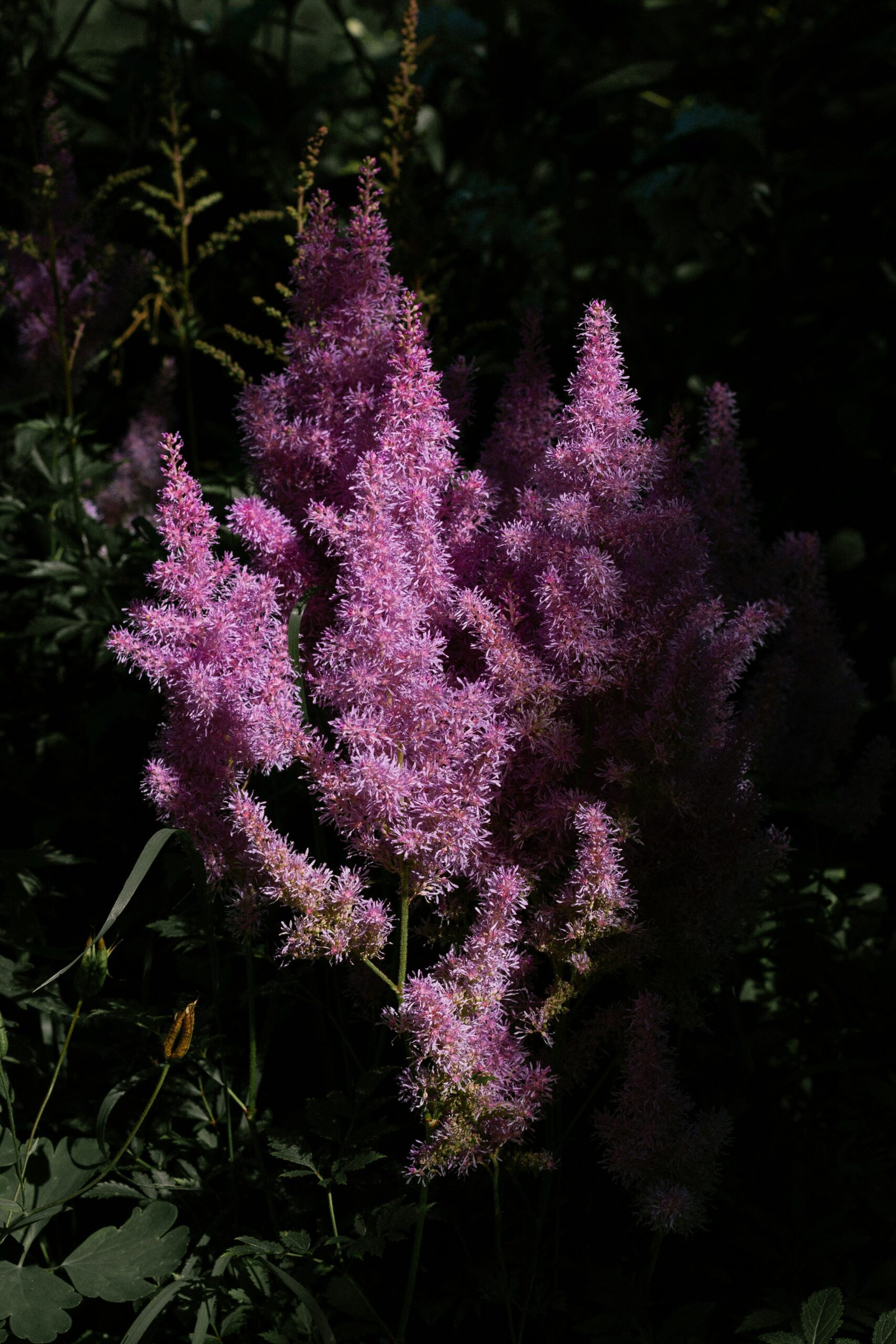
Astilbes are one of the most useful and underused perennials for a damp, shaded UK garden. They produce feathery plumes of flowers in red, pink, white, and deep crimson from June to August — at a time of year when most shade-tolerant plants have finished flowering. The spent flower heads turn bronze and remain attractive through autumn and into winter.
They do need moisture — astilbes in dry shade perform poorly and can die in a drought. In a damp north-facing border, however, they’re outstanding and multiply steadily into generous clumps over the years.
Fanal (deep crimson), Brautschleier (white), and the pink Bressingham Beauty are reliably available in UK garden centres and all perform well in British shade conditions.
6. Epimediums
Epimediums are perhaps the most underrated ground-cover plants in the UK, and they’re absolutely ideal for the difficult dry shade conditions that defeat most other plants. Once established, they form dense, weed-suppressing mats of heart-shaped leaves — some evergreen, many with attractive autumn colour — and produce small but beautifully intricate flowers in spring.
They’re exceptionally drought-tolerant once established, handle the dry root zones under trees and along the base of walls, and require almost no maintenance beyond cutting back the old foliage in February before the new growth and flowers emerge.
Epimedium x rubrum (reddish flowers, red-flushed new foliage), Epimedium x perralchicum ‘Frohnleiten’ (yellow flowers, semi-evergreen), and Epimedium grandiflorum ‘Rose Queen’ are all reliable performers for UK shaded gardens.
7. Pulmonaria (Lungwort)
Pulmonaria is one of the earliest flowering perennials in the UK garden, producing pink-turning-blue flowers from February or March onwards — vital colour and nectar in a shaded border when almost nothing else is going. The silver-spotted leaves are attractive throughout the growing season, providing ground-level interest long after the flowers are over.
They prefer cool, moist conditions and handle north-facing aspects particularly well. They spread steadily by self-seeding but are easy to control. Diana Clare (silver leaves, violet-blue flowers) and Sissinghurst White are among the most ornamental varieties, though even unnamed pulmonaria plants from a garden centre are perfectly worthy.
8. Japanese Anemones
Japanese anemones (Anemone x hybrida) bring tall, elegant flowers — white or pink on wiry stems up to a metre high — to a shaded border from August to October, extending the season long after most shade plants have finished. They’re one of the most graceful late-season perennials in the British garden, and they handle partial shade and north-facing aspects very well.
They do spread over time — the roots run and colonies gradually expand — so they need a position where this can be accommodated, or periodic division to keep them in check. In a large, shaded border they’re ideal.
Honorine Jobert (single white) is the classic variety, reliable and freely available in UK garden centres. September Charm (single pink) and Königin Charlotte (semi-double pink) are equally good.
📖 Also read: One Plant Becomes Twenty for Free — The Beginner’s Guide to Propagating from Cuttings
9. Foxgloves
The native British foxglove (Digitalis purpurea) is a woodland plant that has evolved for exactly the shaded, north-facing conditions that challenge many garden plants. It self-seeds freely once established, producing a new generation of plants each year that tower above the border in June and July with their characteristic spotted purple or white flower spikes.
As a biennial, individual plants flower in their second year and then die, but a self-seeding colony maintains itself indefinitely without any intervention. It’s one of the best plants for naturalising under trees or along the shaded side of a hedge, and the tall spikes add vertical drama that most shade plants can’t provide.
The white form (Digitalis purpurea f. albiflora) is particularly striking in a shaded garden, where the pale flowers seem to glow in low light.
10. Ivy
Common ivy (Hedera helix) is included here not because it needs recommending — it’s everywhere — but because it’s genuinely one of the best solutions for the most difficult spots in a north-facing garden. For dry shade under trees, against deeply shaded north-facing walls, or on a bank where nothing else will establish, ivy solves the problem reliably, evergreen, and with less maintenance than any alternative.
The variegated forms — Glacier, Goldheart, and Buttercup — bring light and colour to dark corners in a way that few other plants can manage. Used thoughtfully with annual cutting back to keep it in its allotted space, it’s one of the most practical plants in the north-facing garden toolkit.
The RHS provides detailed guidance on plants for shade including specific recommendations for different types of shade conditions, varieties, and planting combinations that work particularly well in UK north-facing gardens.
📖 Also read: How to Create a Wildlife-Friendly Garden — The UK Beginner’s Guide to Gardening with Nature
Putting It Together: Creating a North-Facing Garden That Works
The best north-facing gardens in the UK don’t look like compromised south-facing ones. They have their own distinct character — a layered, lush quality, a coolness in summer that feels like a deliberate design choice rather than an accident of orientation.
The key is to think in layers: a canopy layer of large shrubs or small trees (hydrangeas, viburnums, mahonias), a mid-level layer of perennials (hostas, astilbes, Japanese anemones, hellebores), and a ground level layer of spreading plants (epimediums, pulmonaria, ivy). Add the structural verticals of ferns and foxglove spikes and you have a planting that has interest in every month of the year.
North-facing doesn’t mean no garden. It means a different garden — and for the right plants, a better one.
Leave a Reply