Designing a garden that works for children without becoming a bleak expanse of artificial grass and plastic climbing frames is one of the most genuinely interesting design challenges a UK gardener can take on. The goal — a child-friendly garden design that functions as proper play space for children and a proper garden for adults — is more achievable than most people think, and the gardens that pull it off well have certain things in common: clear zones, considered planting, surfaces that are forgiving underfoot, and a respect for the fact that children’s relationship with a garden changes rapidly as they grow.
This guide covers the design principles that make a garden genuinely work for families — not just survive being used by children, but become a place children love and choose to spend time in, while remaining a garden that adults find beautiful and restoring rather than purely functional.
📖 Also read: Kids and Gardening — Tools, Safety, and How to Get Children Genuinely Interested
Start With Zones — Separating Play from Garden
The single most effective structural principle in child-friendly garden design is zoning: creating distinct areas for different activities rather than expecting one undifferentiated space to serve all purposes simultaneously. A clearly defined play area — large enough for the activities the children actually do, surfaced appropriately, and positioned with sightlines from the main living space — allows the rest of the garden to be planted and used as a proper garden rather than a constantly compromised one.
In practice, this often means allocating one section of the garden — typically the part closest to the house and most visible from the kitchen — to play, and designing the rest more freely. The play zone doesn’t have to be large: a 4m × 4m area accommodates a swing, a sandpit, and enough running space for most small children. What matters is that it’s defined, that the surface is safe for falls, and that it’s genuinely the children’s space rather than a compromise between play and planting.
As children grow and their needs change — a toddler’s play area becomes a primary school child’s football pitch becomes a teenager’s outdoor sitting area — the zone can evolve accordingly. Designing it as a flexible space from the outset, rather than installing highly specific permanent equipment, makes these transitions much easier and cheaper.
Surfaces and Materials — Safe, Durable, and Not Depressing
The surface under and around play equipment matters enormously for safety, and it’s an area where many families make choices they later regret. Concrete and paving are too hard for falls. Bark chip is good for impact absorption and relatively inexpensive, but compacts over time and needs topping up every year or two. Rubber safety tiles are excellent — impact-absorbing, durable, and easy to clean — and have come down considerably in price; they’re now a genuinely practical option for a defined play area rather than a specialist installation.
Artificial grass is widely used in family gardens and understandable for low-maintenance reasons, but it has significant downsides: it gets hot in direct summer sun, degrades over time into microplastic fragments, provides no ecological value, and can look convincingly awful within five years. If lawn is important, a robust grass seed mixture with high perennial ryegrass content — sold as “family” or “hard-wearing” lawn seed — will outperform and outlast cheap artificial alternatives in most UK conditions, and it’s real grass.
For paths and transition surfaces, smooth paving or compacted gravel is better than loose or uneven surfaces that trip running children. Round the corners of raised beds and hard structures wherever possible. These small design decisions make the garden genuinely safer without requiring it to look like a padded room.
📖 Also read: Garden Paths — DIY Ideas for UK Gardens
Plants to Avoid in a Child-Friendly Garden
Several common garden plants are toxic enough to warrant removal or relocation in gardens regularly used by young children, particularly those under five who put things in their mouths. The most serious offenders are laburnum (all parts, especially seeds), monkshood or aconite (highly toxic on contact), foxglove (toxic in quantity), yew berries (the red arils are inviting and toxic), and lily of the valley. The berries of many common shrubs — privet, cotoneaster, pyracantha, and holly — are mildly to moderately toxic if eaten in quantity.
This doesn’t mean removing every plant with any level of toxicity — that would leave most UK gardens bare. The practical approach is to remove or fence off the most serious risks (laburnum and aconite in particular), teach children clearly not to eat anything from the garden without asking, and ensure that genuinely toxic berries are not within easy reach of very young children. As children get older and more capable of understanding instructions, the management burden decreases considerably.
Similarly, thorny plants — roses, pyracantha, hawthorn, berberis — should be kept away from play areas and main circulation routes. They’re perfectly fine in borders that children aren’t running through, but a hawthorn hedge bordering a play lawn is an accident waiting to happen.
Plants That Work Brilliantly in a Child-Friendly Garden
Robust, sensory, and ideally edible — these are the qualities that make a plant genuinely valuable in a family garden. Herbs are excellent: lavender (tactile, fragrant, and loved by bees children enjoy watching), mint (almost indestructible, intensely aromatic, and children invariably crush the leaves to smell them), rosemary, and thyme all add sensory interest and can be touched, smelled, and picked freely without damage to the plant or the child.
Ornamental grasses work beautifully near play areas — they’re completely safe, movement and tactile interest in a way children respond to instinctively, and they wave and rustle in wind in a way that brings the space to life. Sunflowers, cosmos, and nasturtiums add colour and scale without any toxicity concerns. Strawberries in ground-level planters alongside a play area are a perpetual source of delight — accessible, edible, and endlessly interesting to check on.
For structure and definition, native hedging rather than formal clipping suits a family garden well — it grows fast enough to establish boundaries and provide screening, it’s wildlife-rich, and the occasional berry (on species that are safe) or interesting seed head gives children something to notice and investigate. Hawthorn and blackthorn kept away from the immediate play area, field maple, and dog rose are all excellent choices for informal native boundaries.
📖 Also read: The Best Plants to Grow with Children — Fast Results That Keep Kids Hooked
Including a Growing Area — Children’s Own Space
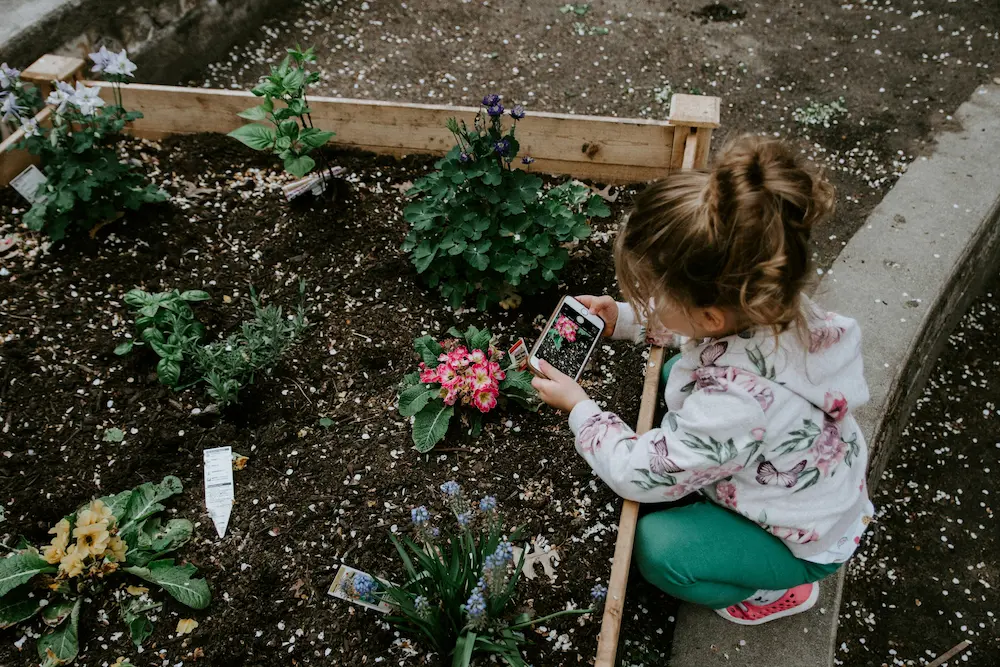
A dedicated growing area for children — even a single raised bed or a row of pots — transforms a family garden from a space children use into a space they’re invested in. The key design principle is ownership: it needs to be clearly and unmistakably theirs, not a corner of the vegetable garden they’re allowed to borrow. A small raised bed at child height (ideally no taller than 30–40cm so small children can reach the centre), positioned where they pass it daily, labelled with their name, and planted entirely with their chosen seeds, will hold interest through a season in a way that a shared family vegetable plot never quite does.
Position the children’s growing area where it gets good sun — at least five to six hours a day — and keep it close to a water source. Children who have to walk a long way to fill a watering can will water less frequently, and underwatered plants teach the wrong lesson about gardening. A small dedicated watering can stored near the bed removes all the friction from the daily watering routine.
Water Features — Balancing Appeal and Safety
Water is endlessly compelling to children, which makes water features both a huge asset and the most significant safety consideration in a family garden. Any open water — a traditional garden pond — must be securely fenced or covered if used by children under five. A rigid metal grid fitted at water level across a pond surface is the safest solution; it’s invisible from above, doesn’t alter the look of the pond, and prevents immersion even if a child falls onto it.
Self-contained water features — pebble fountains, millstone features, and bubble pools — offer the sight and sound of moving water with no open water hazard, making them an excellent family-friendly alternative to a traditional pond. A shallow pebble pool where children can splash and play deliberately is another approach: designed for interaction rather than prohibited from it, it removes the forbidden-fruit problem entirely while giving children a genuine water play experience.
📖 Also read: Solar Garden Fountains — How to Choose, Place, and Maintain One in a UK Garden
Thinking Long-Term — Designing for How the Garden Will Grow
The most important thing to understand about child-friendly garden design is that children’s needs change faster than gardens do. A toddler play area is redundant by the time a child is eight. A trampoline that dominates the garden at ten is embarrassing by fifteen. Designing with transitions in mind — choosing structures and surfaces that can be repurposed rather than only removed, leaving flexibility in the layout for the garden to evolve — makes the whole thing far less expensive and frustrating as the children grow.
The garden that genuinely works for families is one designed with both generations in mind from the start: not a children’s garden with some adult concessions, and not an adult garden reluctantly accommodating children, but a space where both can be comfortably themselves at the same time. That balance — space to run, something growing, somewhere to sit, and something always worth noticing — is exactly what the best family gardens achieve, and it’s well within reach of any UK garden regardless of size or budget.
Leave a Reply