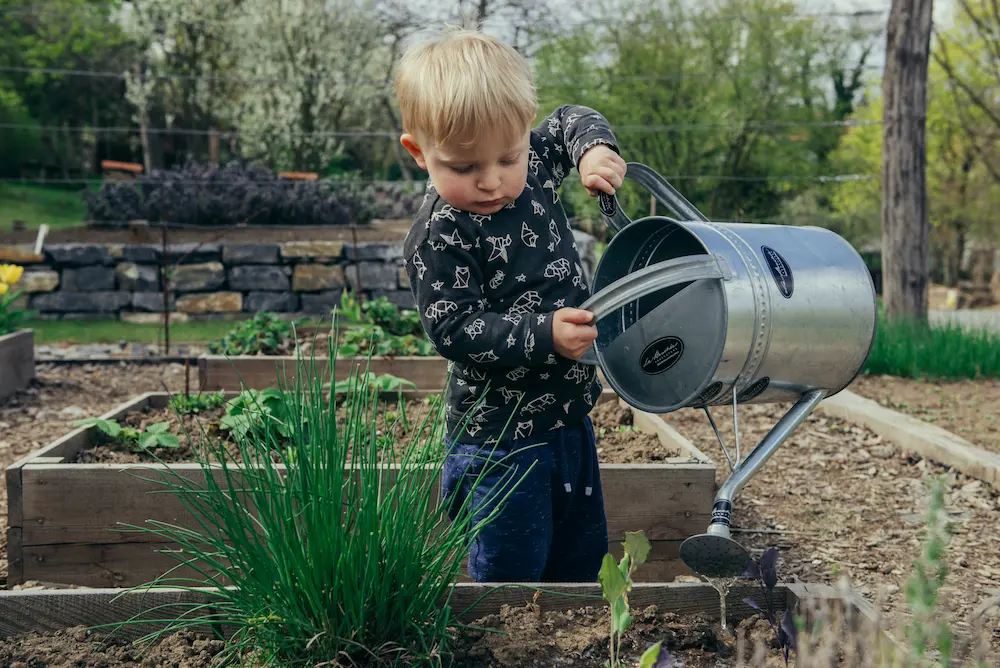
Getting children interested in gardening is one of those things that sounds simple and can be genuinely transformative — for them, and for you. A child who understands where food comes from, who has grown something from seed and eaten it, who has learned to be still and patient enough to watch a bee work a flower, has picked up something that no classroom can quite replicate. Kids and gardening in the UK go back a very long way, from school allotment plots to the RHS Campaign for School Gardening, and the evidence that it benefits children — in terms of confidence, outdoor connection, and even diet — is well established. The challenge is not convincing children that gardening is worthwhile. It’s making it genuinely engaging rather than an adult-led exercise they’re merely tolerating.
This guide is for parents, grandparents, and anyone else who wants to bring a child into the garden without it becoming a chore. The key — and it applies to every age group — is speed, ownership, and edibility.
📖 Also read: Easiest Vegetables to Grow in the UK for Beginners
Why Children Lose Interest — and How to Prevent It
The most common reason children disengage from gardening is the gap between action and result. An adult can sow a row of parsnips in April, wait patiently until December, and feel the satisfaction of a long-term project fulfilled. A six-year-old cannot. Children need feedback loops that are measured in days, not months. If you want kids to stay engaged with gardening, you need to choose plants and projects that produce visible results quickly — ideally within a week, certainly within a fortnight.
The second engagement-killer is feeling like a helper rather than an owner. Children are far more invested in a garden project when it’s genuinely theirs — their own patch, their own pot, their own seed packet that they chose themselves from the rack. Even a small area of ownership makes an enormous difference. A 60cm square patch of soil, clearly marked as belonging to one child, will hold their attention far longer than hours spent “helping” with the main garden.
The Best Plants for Kids to Grow in a UK Garden
Fast-germinating, edible, and dramatic — these are the three qualities that make a plant genuinely exciting for children. Radishes are possibly the single best starter plant for young children: sow to harvest in as little as 25 days, bright red, crunchily edible straight from the ground, and so reliable that failure is almost impossible. The speed alone is astonishing to a child who has just watched you push a seed into soil.
Sunflowers are the other classic for good reason. The seed is big enough for small hands to handle, germination is fast, and the growth is so rapid and dramatic — from seedling to towering flower in a few months — that it holds attention across a whole season. A height competition between siblings or classmates adds an extra layer of investment that keeps children checking on their plant daily.
Cherry tomatoes are excellent for slightly older children (seven and upwards) who can manage a little more patience. Growing them on a sunny windowsill means no outdoor access is needed, and harvesting and eating the fruits directly from the plant — warm from the sun — is one of the most satisfying gardening moments available to a child at any age. Strawberries are similarly compelling: easy to grow in pots, and the payoff of picking and eating your own strawberries is immediate and obvious.
For projects with a slightly longer timeline, peas are wonderful — children can shell and eat them raw straight from the pod, the tendrils and flowers are interesting to observe, and the process of building a wigwam for the plants to climb gives children a genuine construction project alongside the growing one. Courgettes are almost comedically productive and fast-growing, which children find both impressive and hilarious.
📖 Also read: How to Grow Cherry Tomatoes on a Windowsill — No Garden Needed
Choosing the Right Tools for Children
Proper children’s tools make a genuine practical difference, not just a psychological one. Adult-sized spades and forks are too heavy and unwieldy for most children under ten, and using them is frustrating rather than satisfying. A set of child-sized tools — a small trowel, a hand fork, a watering can of the right size and weight when full — allows children to do the actual work themselves rather than watching an adult do it for them.
Invest in decent quality rather than cheap toy versions. Brands like Burgon & Ball and Felco make genuinely robust children’s gardening sets that will last years; flimsy plastic tools that bend at first use are demoralising and wasteful. For older children (ten and above), a proper small-bladed pruner, used under supervision, gives them access to tasks that feel grown-up and responsible — deadheading, cutting herbs, harvesting — rather than the basic digging and watering that can start to feel repetitive.
A child’s own set of tools, stored in a dedicated spot, creates a sense of kit and readiness that reinforces their identity as a gardener. Keep their tools clean and functional — a rusty, blunt trowel communicates that their tools don’t matter, which by extension communicates that their gardening doesn’t matter.
Garden Safety for Children — What Actually Matters
Most gardens are safe for children with common-sense precautions rather than extensive childproofing. The genuinely important safety considerations are water, toxic plants, and tool handling. Any open water — ponds, water features, water butts — should be secured, covered, or fenced off for children under five. A small child can drown in very shallow water, and this risk should be taken seriously regardless of how supervised you believe the child to be.
Certain common garden plants are toxic if ingested: foxglove, monkshood (aconite), laburnum, yew berries, lily of the valley, and the berries of many shrubs including privet and cotoneaster. None of these need to be removed from a garden with older children who understand not to eat plants without permission, but in gardens used by toddlers who put everything in their mouths, it’s worth identifying and either removing or fencing off the most toxic specimens.
Teach tool safety as you would any skill — clearly, consistently, and without drama. Show children how to carry tools safely (blades down, points away from the body), where to put them down (flat on the ground rather than leaning), and how to use them correctly. Children who are taught tool safety properly from the start rarely have accidents; children given tools with no instruction are the ones who get hurt.
📖 Also read: How to Grow Peas in the UK
Projects That Work Brilliantly with Children
A sunflower height competition — each child (or each family member) grows one plant from seed, and the tallest at the end of summer wins — is a perennial favourite that requires almost no adult intervention once the seeds are sown. Similarly, a bean-in-a-jar project, where a runner bean seed is placed between damp kitchen paper and the glass side of a jar, allows children to watch germination and root development in real time — genuinely fascinating for young children and an excellent introduction to how plants work.
A dedicated children’s wildlife patch — a small area left deliberately wild with nettles (for butterflies), long grass, and a log pile — gives children ownership of a space that looks different from the tidy adult garden and connects them to the wider ecological picture. Combine it with a bug hotel made from bamboo canes, pine cones, and old bricks, and you have an ongoing observation project that holds interest through multiple seasons.
Growing a giant pumpkin for Halloween is consistently one of the most motivating long-term projects for children aged six to twelve. Sow in late April, plant out in June, feed regularly through summer, and the child has a project with a very specific, exciting deadline and a result that is both enormous and highly shareable. The entire growing season becomes purposeful rather than open-ended.
Making It a Habit Rather Than an Event
The children who grow up genuinely loving gardens are almost never the ones who had one big gardening day each year. They’re the ones for whom small garden moments were woven into the ordinary fabric of daily life — checking on seedlings on the way to school, watering a pot on the back step, picking a few herbs before dinner, noticing a snail, catching a ladybird. These small, frequent interactions build a relationship with the garden that no single project, however well-designed, can replicate.
The most effective thing any adult can do is to be genuinely interested themselves — to talk about what’s growing, to point out what’s changed since yesterday, to involve children in decisions rather than just tasks. Children who feel that the garden is interesting to the adults they love will find it interesting themselves. That’s where the real engagement comes from — not from the perfect project or the right tools, but from the sense that the garden is a place worth paying attention to.
📖 Also read: How to Grow Cosmos in the UK
Leave a Reply