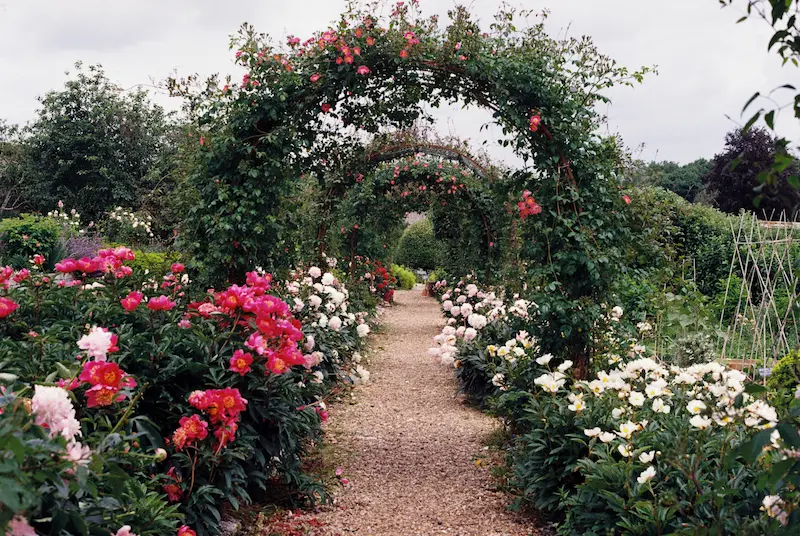
A garden arch is one of the most powerful design tools available to a UK gardener, and one of the most underused. It costs far less than a pergola, takes up almost no ground space, can be installed in an afternoon, and has the ability to transform a flat, directionless garden into something with genuine structure, romance and intention. Garden arches in the UK have enjoyed a surge of popularity in recent years — and rightly so, because few other features deliver such a dramatic visual return for such a modest investment. Whether you want to frame a path, mark the entrance to a different area of the garden, or simply give a climbing rose somewhere beautiful to grow, an arch is the answer.
The decisions to make are simpler than most people think: what material, what size, where to put it, and what to grow over it. Get those four things right and the arch will look intentional and beautiful from the moment it goes in — and spectacular once the plants get going.
📖 Also read: How to Plan Your Garden Before You Spend a Single Penny
Choosing the Right Material — Timber, Metal or Plastic?
The material your arch is made from affects how it looks, how long it lasts, and how much maintenance it needs — and in the UK’s reliably damp climate, durability matters more than it might elsewhere. Timber arches are the most popular choice and, when well made from hardwood or pressure-treated softwood, look genuinely beautiful. Rustic, sawn timber suits cottage and country gardens perfectly; planed, painted timber works well in more formal or contemporary settings. The main consideration with timber is maintenance — bare softwood will need treating with preservative every two to three years, while painted arches need occasional re-painting to prevent the underlying wood from deteriorating.
Metal arches — typically galvanised steel or powder-coated iron — are increasingly popular and offer a longer, more maintenance-free lifespan than timber. A good quality metal arch, properly powder-coated, should last fifteen to twenty years without significant rust, even in a wet Welsh or Scottish garden. They tend to have a more elegant, slender profile than timber arches, which suits roses and delicate climbers beautifully, and the dark green or black finishes that most come in disappear visually once covered in foliage. The main weakness is stability — metal arches are lighter than timber ones and need their legs set firmly in the ground (or in ground anchor spikes) to resist wind, particularly once loaded with the weight of a mature rose or clematis.
Plastic arches are worth a brief mention only to advise caution. They may be cheap and technically maintenance-free, but they look exactly as cheap and plastic as they are, they become brittle with UV exposure, and they’re rarely strong enough to support the weight of a mature climber without flexing or cracking. In a garden that will be photographed, shown to visitors, or simply looked at from the kitchen window, the difference between a decent metal or timber arch and a plastic one is very noticeable.
Size and Proportion — Getting Garden Arches Right in UK Gardens
An arch that’s too small looks cramped and apologetic; one that’s too large for its setting looks like a structural statement that wasn’t quite thought through. As a general rule, arches should be tall enough that an average-height adult can walk through comfortably without ducking — which, once you add the drooping stems of a rose or clematis in full growth, means the bare frame needs to be at least 2.1 to 2.2 metres tall at its highest point. Standard garden arches sold in the UK are typically 1.9 to 2.0 metres tall at the apex, which is fine for a planted path where you’ll be passing through occasionally; if the arch is over a main route or used daily, go taller.
Width is equally important. An arch over a path should be at least 90cm wide — wider if two people might walk through side by side, or if you’re pushing a wheelbarrow or bike through regularly. Arches placed as standalone focal points at the end of a view, or framing a gate, can be narrower. Pay attention too to the depth of the arch from front to back: a deeper arch — 60cm or more — feels more immersive to walk through and is more stable once planted up. Many flat-pack arches are quite shallow, which can look fine initially but feels insubstantial once you’re standing beneath it.
📖 Also read: How to Layer Plants in a Border — The Simple Trick That Makes Any UK Garden Look Designed
Where to Position a Garden Arch for Maximum Impact
Placement is where most garden arches either succeed or fail as design features. The most effective positions share one characteristic: they mark a transition or frame a view. An arch placed at the point where one area of the garden gives way to another — between the patio and the lawn, between the kitchen garden and the ornamental garden, at the entrance through a hedge — makes immediate sense to the eye. It signals that you’re moving from one space into another, and it creates anticipation. Even in a small garden with only one coherent space, an arch placed at the far end frames the view from the house and gives the garden depth that it otherwise lacks.
An arch placed randomly in the middle of a lawn, with nothing marking where or why it is, tends to look marooned and purposeless however beautiful the plants growing over it might be. If you’re not sure where to put one, the simplest test is to stand at the main viewing point — usually a window or back door — and imagine looking through the arch to something beyond it. If you can picture a path leading through it to a bench, a pot, a statue or a view, the position will work. If there’s nothing beyond it to look at, it needs moving or that something-beyond needs creating first.
The Best Climbing Plants for Garden Arches in the UK
This is where garden arches in the UK genuinely come alive, and the choice of climber makes an enormous difference to how the arch looks across the seasons. The most important practical consideration is scale — choose a climber whose natural vigour matches the size of your arch. A rampant rambling rose will overwhelm a small decorative metal arch within two seasons; a delicate annual sweet pea will look lost on a large, heavy timber one.
Climbing roses are the classic arch plant in the UK, and for good reason. A repeat-flowering climbing rose like ‘Compassion’ (rich apricot-pink, exceptional scent) or ‘Golden Showers’ AGM (yellow, reliably repeat-flowering, relatively compact) suits a standard arch perfectly — vigorous enough to cover the structure in two to three seasons, but controllable enough not to engulf it. For a smaller arch or a first arch, ‘Warm Welcome’ is an excellent miniature climber that produces a mass of small, orange-flame flowers on naturally compact growth that won’t need constant restraining.
Clematis is arguably the perfect arch plant — its slender stems add little weight to the structure, it flowers over a long period, and many varieties combine effortlessly with roses on the same arch. The RHS clematis growing guide is the most comprehensive resource for choosing the right variety and pruning group for your situation. For arches, Group 2 large-flowered clematis like ‘The President’ (deep purple-blue) or ‘Nelly Moser’ (pale pink with a deep pink bar) are ideal — they flower twice in a season, in May and again in August, and their pruning requirement is light enough to maintain without disturbing a rose growing alongside them.
📖 Also read: How to Grow Clematis in the UK — The Beginner’s Guide to the Queen of Climbers
Scented Climbers — The Arch Plants That Reward You as You Walk Through
An arch over a path offers something a pergola or wall-trained plant can’t quite match: the experience of walking through a cloud of scent. This is one of the most sensory pleasures a garden can offer, and choosing a strongly fragrant climber for a walkway arch elevates the feature from decorative structure to genuine experience. Honeysuckle — particularly Lonicera periclymenum ‘Serotina’ AGM or ‘Graham Thomas’ AGM — is perhaps the most intensely scented climber for UK conditions, producing that unmistakable sweet fragrance in the evenings of June and July. It covers an arch quickly, tolerates partial shade better than most climbers, and is extraordinarily easy to grow.
Sweet peas (Lathyrus odoratus) used as annual climbers on a metal arch are a wonderful short-season option — they’re quick from seed, extraordinarily scented, and can be pulled out and composted at the end of summer without any commitment. They’re particularly good in a kitchen garden setting where a decorative metal arch would look out of place with a permanent woody climber. Grow them through a few twiggy sticks pushed into the ground at the base of the arch in spring, water regularly, and cut the flowers constantly — the more you pick, the more they produce.
📖 Also read: How to Grow Sweet Peas in the UK — The Most Scented Climber in the Garden
Planting and Training Climbers on Garden Arches in the UK
The most common mistake when planting up a garden arch is placing plants too close to the base of the uprights. Most arches have their legs set into the ground or into sockets, and the soil right at the base of a metal or timber upright is often poor, compacted and dry. Plant 20–30cm away from the upright on each side, angling the plant towards the arch with a short cane to guide it. Improve the planting hole generously with garden compost or well-rotted manure, particularly for roses and clematis, which are hungry plants that benefit from a rich start.