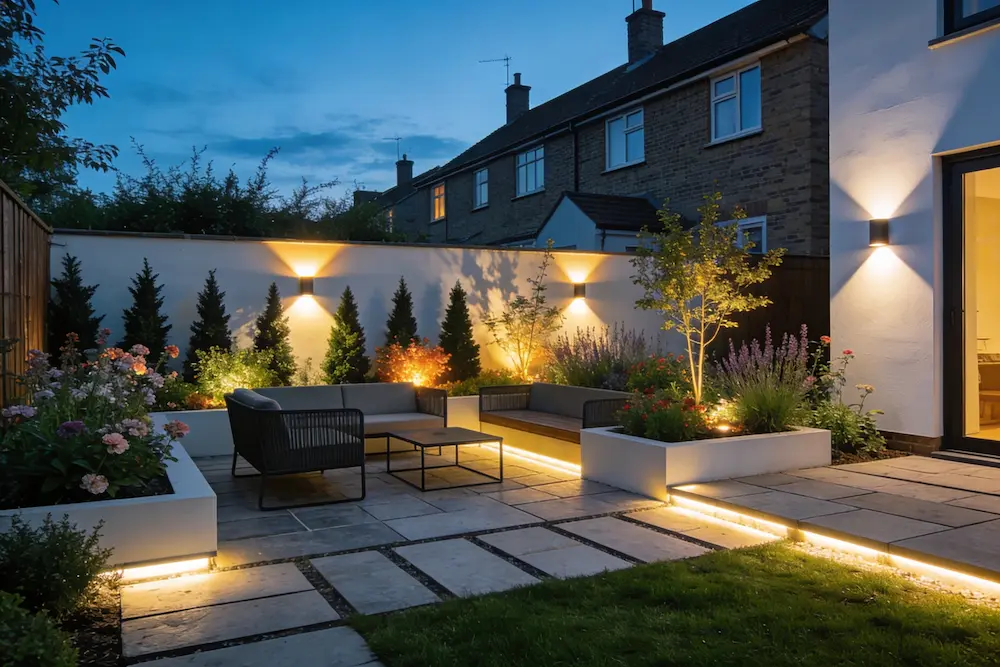
Garden lighting changes everything. A garden that looks perfectly pleasant in daylight can become something genuinely magical at night with the right lights placed in the right spots — deep shadows, pools of warm light, the silhouette of a tree thrown against a wall. Done well, garden lighting UK-style extends the usable hours of your outdoor space by months, brings you outside on summer evenings that would otherwise be wasted, and transforms a space you thought you knew into something that looks completely different after dark.
Done badly, it looks like a car park. The difference between the two is less about budget than it is about restraint, placement, and understanding what you’re actually trying to achieve before you start drilling holes and running cables.
📖 Also read: How to Plan Your Garden
Why Garden Lighting Is Worth Taking Seriously
In the UK, where the evenings are dark for a good six months of the year, garden lighting is less of a luxury and more of a practical investment. It means you can use a terrace or seating area through spring and autumn evenings when you’d otherwise be looking at darkness through the glass. It means returning home to a garden that looks welcoming rather than gloomy. And if you’ve invested time and money in your planting, decent lighting means that investment doesn’t disappear the moment the sun goes down.
Beyond the practical benefits, there’s a real design opportunity here. The way a plant looks at night — lit from below, casting shadows upward — is entirely different from how it looks in daylight. Architectural plants like phormium, bamboo, and grasses become dramatic and sculptural. A simple silver birch, uplighted from the base, looks like something from a film set. Garden lighting is not just about making things visible; it’s about choosing which things to celebrate.
Planning Your Garden Lighting UK Design
Before buying a single fitting, spend time in your garden after dark. Take a torch and walk around, pointing it at different plants, features, and structures to see what looks interesting when lit. Most people are surprised to discover that the things that catch the eye at night are quite different from the focal points they’ve designed for daytime — a fence post that’s invisible by day becomes a dramatic vertical at night, while a sprawling flower border that’s glorious in summer disappears into a muddy mass after dusk.
Make a note of three or four key features you’d like to highlight, and plan your lighting around those rather than trying to illuminate everything. Less is genuinely more with garden lighting. A well-placed spotlight on a single structural tree, combined with subtle path lighting and a warm glow around the seating area, will always look better than a dozen different light fittings dotted randomly around the garden like a Christmas decoration.
For broader garden design inspiration and guidance, the RHS garden design hub is an excellent starting point, covering everything from planting combinations to structural elements and seasonal interest.
📖 Also read: Pergolas — How to Choose the Right One, Where to Put It, and What to Grow Over It
Types of Garden Lighting and What Each Does Best
Uplighters are ground-level spotlights aimed upward into a plant, tree, or architectural feature. They create the most dramatic effects — deep shadows, strong contrasts, and an almost theatrical quality that’s particularly effective with trees, large grasses, and structural plants. Most garden designers use uplighters sparingly, as anchor points in the lighting scheme rather than general illumination.
Downlighters are mounted above — on a wall, a pergola beam, or a tall post — and cast light downward onto a seating area, path, or planting. They’re more practical than uplighters, providing usable light for eating and conversation, and they tend to look more natural since they mimic the way moonlight falls. String lights and festoon bulbs strung between pergola posts work on the same principle and are extremely popular for UK outdoor entertaining spaces.
Path and step lights serve a primarily functional purpose — making it safe to navigate the garden at night — but they also add a quality of gentle, consistent warmth to a garden’s atmosphere. Low-level bollard lights along a path, or small recessed lights set into the risers of steps, work well without dominating the space visually.
Submersible pond lights are transformative if you have water in the garden. Lit from below at night, a pond becomes luminous — fish, plants, and reflections all made suddenly vivid. Cool white or blue-white light works best for water features; warm amber tones, which suit planting beautifully, tend to make water look murky.
📖 Also read: Garden Arches — How to Choose One and Which Climbing Plants Look Best Over Them
Solar vs Mains-Powered Garden Lighting UK
Solar lighting has improved dramatically in the last decade. Modern solar path lights and spotlights from brands like Philips Hue, Ring, and Lutec are genuinely reliable and bright enough for practical use — though they’re still most suited to areas with good sun exposure and for lower-level path or ambient lighting rather than dramatic uplighting. The obvious advantage is no cabling and no running costs, which makes solar the natural choice for quick wins and portable applications.
The limitation is reliability. In the UK, solar lights work brilliantly from April to September but can be patchy through winter and in north-facing spots that receive limited direct sun. If you want consistent, reliable, high-quality lighting through autumn and winter — when it matters most in a UK garden — low-voltage mains-connected LED systems are still the better choice for key features. A 12V transformer connected to a run of outdoor cable, with individual LED spike lights and path fittings plugged in along it, is a system that anyone with basic DIY confidence can install and which will give you professional-quality results.
Choosing Light Colour Temperature
Colour temperature — measured in Kelvin — is one of the most important decisions in garden lighting and one that’s often overlooked. Warm white light (2700K–3000K) suits planting, timber structures, and entertaining spaces beautifully. It feels welcoming and natural, similar to candlelight or a traditional tungsten bulb, and it makes green foliage and warm-toned materials glow rather than wash out.
Cool white or daylight bulbs (4000K–6500K) are better suited to contemporary gardens with a lot of concrete, steel, and pale stone — they emphasise clean lines and geometry rather than softening them. They’re also better for water features, as noted above. Mixing colour temperatures in the same garden tends to look confused and accidental, so choose one and stick to it across the whole scheme.
📖 Also read: Garden Paths — DIY Ideas for UK Gardens
Garden Lighting and Wildlife
It’s worth thinking about the impact of garden lighting on wildlife, particularly if you’ve worked to make your garden welcoming to hedgehogs, moths, and bats. Bright, wide-coverage lighting can disrupt nocturnal animals and confuse moths, which navigate by moonlight and are badly affected by artificial light pollution. The best approach is directional lighting that illuminates specific features rather than broad-area floodlighting, motion-sensor switches that only activate when someone is actually in the garden, and a preference for warmer light temperatures over cool blue-white, which is more disruptive to insects.
Hedgehogs in particular benefit from dark corridors at the base of boundaries, so avoid lighting the ground level of fences and walls if you want to keep your garden wildlife-friendly. A dark boundary with a brightly lit seating area and a few uplighted trees gives you both worlds — a beautiful garden after dark and a safe habitat for the creatures that use it.
The Plants That Look Best Under Garden Lighting UK
Not every plant rewards lighting equally. The best performers under artificial light share certain qualities: strong architectural form, interesting silhouettes, pale or silver foliage that catches and reflects light, or glossy leaves that throw back a spotlight rather than absorbing it.
Silver birch and multi-stemmed trees with pale bark are exceptional — the bark glows luminously under warm uplighting and the branching structure becomes beautiful and complex in the shadows it creates. Bamboo, phormium, and ornamental grasses move in the breeze and create shifting patterns on walls and fences when lit from below. Topiary — a clipped ball or cone of box or yew — gains a crisp, sculptural quality at night that makes even a modest specimen look considered and intentional. For a softer approach, pale-flowered plants like white agapanthus, hydrangeas, and white-flowering climbing roses are all but luminous after dark, glowing faintly even in ambient light.
📖 Also read: Topiary for Beginners — How to Shape Shrubs and Create Structure in a UK Garden
Starting Simply and Building Over Time
Garden lighting is one of those projects where starting simply and adding over time is almost always better than attempting a complete scheme all at once. Begin with one key feature — a tree, a seating area, or a path — and live with it for a season before expanding. You’ll quickly discover what works and what doesn’t, where the shadows fall, and which plants genuinely reward the attention.
The best garden lighting UK schemes tend to evolve gradually, plant by plant and season by season, as the garden itself grows and changes. A garden that takes ten years to develop its planting usually takes just as long to develop its lighting — and that’s not a sign of failure, it’s just how good gardens work.
Leave a Reply