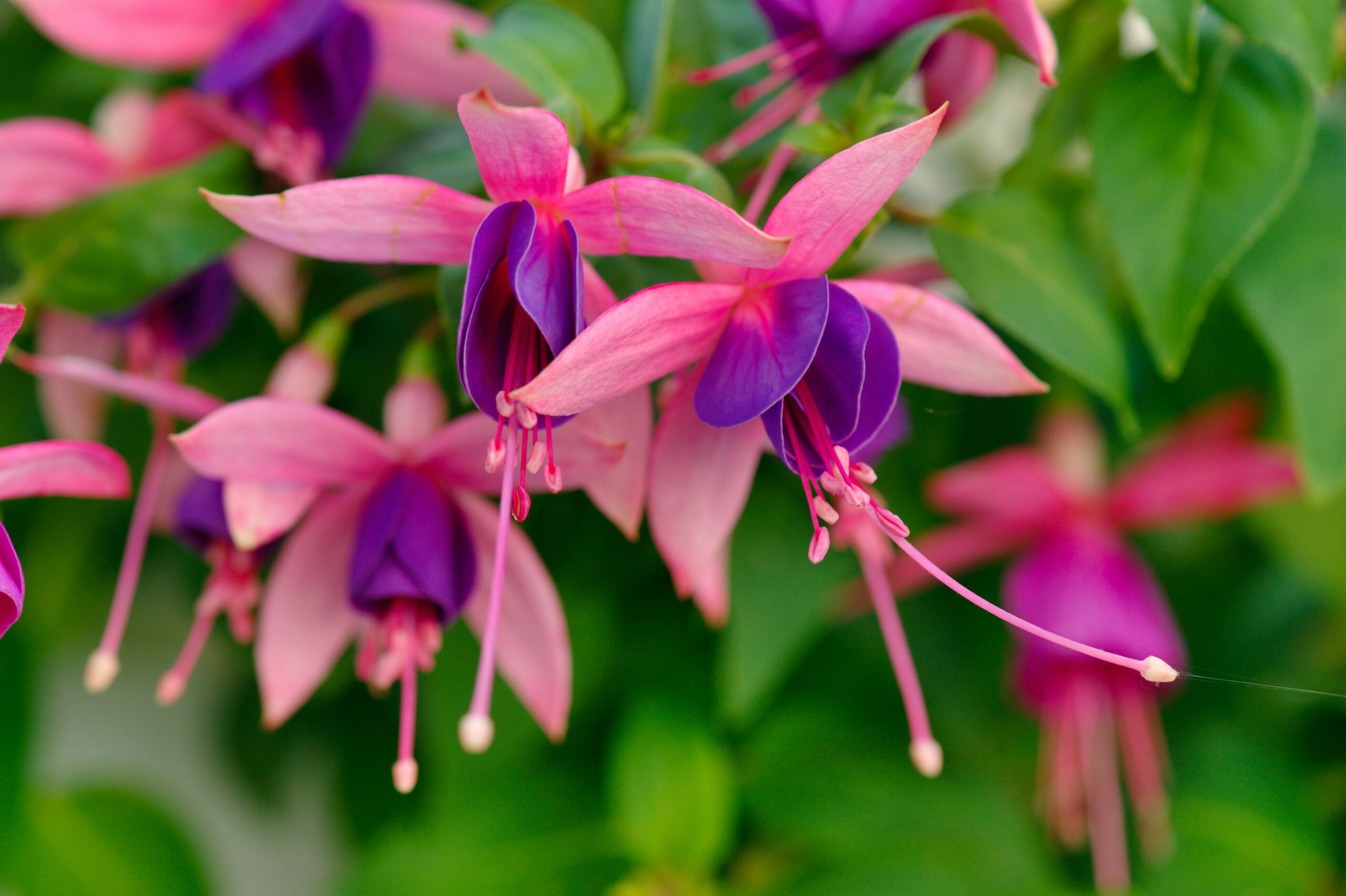
How to grow fuchsias in the UK is a question with a longer and more interesting answer than most people expect. How to grow fuchsias in the UK covers everything from trailing varieties cascading out of hanging baskets on a July doorstep to fully hardy shrubs that survive Yorkshire winters without so much as a fleece. Fuchsias are one of the most varied and rewarding flowering plants available to British gardeners — and yet they’re often dismissed as something your grandmother grew, rather than the genuinely versatile, long-flowering plants they are.
The dangling, jewel-like flowers in combinations of purple, pink, red, and white are unlike anything else in the garden. They flower prolifically from early summer right through to the first frosts, they attract bumblebees and hummingbird hawk-moths, and with a basic understanding of their needs — particularly around overwintering — you can keep the same plants going for years.
Hardy vs Half-Hardy: Understanding the Difference
The single most important thing to understand about fuchsias is that there are two fundamentally different groups, with very different care requirements.
Hardy fuchsias survive outdoors in the UK year-round in most parts of the country. They die back to ground level in a hard winter but regenerate from the roots in spring. Fuchsia magellanica and its cultivars are the classic hardy types — they’re widely naturalised in mild coastal areas of Cornwall, Wales, and western Scotland, where they form substantial hedges. In a sheltered border, a hardy fuchsia will grow to 90cm–1.5 metres and flower continuously from June to October. These need minimal care: a hard cut back in late spring once new growth appears from the base, and that’s essentially it.
Half-hardy fuchsias — which include most of the trailing and large-flowered varieties sold in garden centres — are tender and will be killed by frost. These are the ones used in hanging baskets, patio containers, and summer bedding schemes. They need to be brought under cover before the first frost in autumn and kept frost-free over winter. In return for this extra effort, they offer much larger, more extravagant flowers and a wider range of colours and forms than the hardies.
Most UK gardeners grow both — hardies in the border for permanent, low-maintenance colour, and half-hardies in containers for the summer show.
📖 Also read: Hanging Flower Baskets in the UK
Choosing Varieties
The range of fuchsia varieties available in the UK is enormous — there are thousands of named cultivars — so it’s worth narrowing down by use.
For hanging baskets and trailing displays: Look for varieties described as “trailing” or “basket” types. ‘Golden Marinka’ has red flowers and attractive yellow-green foliage. ‘Swingtime’ produces large red and white double flowers on long trailing stems. ‘Trailing Queen’ is a classic, prolific, and widely available. ‘Cascade’ has delicate single flowers in white and deep pink and is one of the most elegant trailing varieties.
For upright containers and patio pots: Bush-type half-hardies like ‘Tom Thumb’ (compact, red and purple, surprisingly hardy), ‘Mrs Popple’ (vigorous, red and purple, one of the hardiest), and ‘Delta’s Sarah’ (white and pink double flowers) work well in individual pots.
For borders (hardy types): Fuchsia magellanica ‘Riccartonii’ is the most commonly grown hardy fuchsia in the UK — slim red and purple flowers on an arching shrub that can reach 1.5 metres in a sheltered spot. ‘Hawkshead’ is a beautiful all-white hardy variety. ‘Genii’ has golden-yellow foliage that lights up a shaded border even before the flowers appear.
As standards: Fuchsias can be trained as standards — a single upright stem topped with a ball-shaped head — which look spectacular in formal containers or flanking a doorway. Training a standard takes a full growing season but is entirely achievable as a DIY project.
Planting and Position
Half-hardy fuchsias go outside after the last frost — in most of the UK, this means late May or early June. Before then, they should be kept frost-free under cover.
Fuchsias prefer a position with bright indirect light rather than full scorching sun — they’re one of the few flowering plants that actually perform better in partial shade. A north or east-facing wall that gets morning sun but afternoon shade is often ideal. Full midday sun in a hot summer can bleach the flowers and stress the plants, though in a typical British summer this is rarely a serious problem.
For hanging baskets, use a specialist basket compost with added water-retaining gel — fuchsias in baskets are thirsty plants that will need daily watering in summer. Line wire baskets with coir liner or moss, fill generously with compost, and plant trailing varieties around the sides as well as the top for a full, cascading effect.
For containers, use a good quality multipurpose or peat-free compost. Ensure the pot has adequate drainage — fuchsias don’t like sitting in waterlogged compost.
Hardy fuchsias can be planted in borders from May to September. They prefer a rich, moisture-retentive soil and appreciate a mulch of well-rotted compost in spring.
Pinching Out for a Better Display
Pinching out is the technique that transforms a sparse, leggy fuchsia into a dense, floriferous plant — and it’s simple to do.
When young plants have produced two or three pairs of leaves, pinch out the very tip of each growing shoot between your finger and thumb. This forces the plant to produce two new shoots where there was one, doubling the number of flowering tips. Repeat this process two or three times as the plant grows, each time pinching out the tips of the newest shoots.
Stop pinching out about six to eight weeks before you want the plant to flower — each pinch delays flowering by that amount. For a July display in a hanging basket, stop pinching by mid-May.
Plants bought from garden centres in spring have usually already been pinched once or twice by the nursery, but a further pinch when you get them home produces an even bushier result.
Feeding and Watering
Fuchsias in containers are hungry, thirsty plants. Once they’re growing strongly — from about four weeks after planting — feed every week with a high-potassium liquid fertiliser. Tomato feed is ideal and inexpensive. This feeding regime drives flower production and keeps the display going from June right through to October.
Watering frequency depends on the weather and the container. Hanging baskets in a warm, breezy position may need watering twice a day in hot weather — check by inserting a finger into the compost; if it’s dry an inch below the surface, water thoroughly. Self-watering baskets with a reservoir at the base significantly reduce this demand and are worth considering if daily watering feels onerous.
Hardy fuchsias in borders need much less attention — water during prolonged dry spells in their first season while establishing, and occasionally in very dry summers thereafter. Once established they’re fairly self-sufficient.
📖 Also read: 10 Flowers That Attract Bees to Your UK Garden
Overwintering Half-Hardy Fuchsias
This is the stage where many gardeners lose their fuchsias unnecessarily — either because they leave them outside too late and lose them to frost, or because they bring them in but don’t know how to maintain them through winter.
When to bring them in: Before the first frost — in most of the UK, this means sometime in October, though in mild coastal areas you may get away with later. Watch the weather forecast; a light frost warning is the signal to act.
How to overwinter: The goal is to keep the plant alive but dormant through winter, not to keep it actively growing. Move plants to a frost-free but cool space — an unheated greenhouse, a cool spare bedroom, a frost-free garage or shed with some light. Reduce watering dramatically: just enough to stop the compost drying out completely, perhaps once every two to three weeks.
The leaves will drop — this is normal and expected. What you’re keeping alive is the woody stem structure and the root system. The plant looks dead through winter but isn’t.
In late February or early March, move plants to a slightly warmer, lighter position and begin watering more regularly. New growth will appear within a few weeks. When it does, cut back the previous year’s stems by about half, repot into fresh compost if the roots are congested, and begin feeding again once growth is vigorous. Harden off before putting outside after the last frost.
Done this way, a half-hardy fuchsia can be kept and grown for many years, becoming a larger and more spectacular plant each season.
Taking cuttings as insurance: Even if you successfully overwinter your plants, taking a few cuttings in late summer is good insurance. Soft tip cuttings of 7–10cm root readily in a pot of multipurpose compost on a bright windowsill. They take up much less space over winter than a whole basket plant and are easy to bring on the following spring.
📖 Also read: How to Grow Hydrangeas in the UK
Common Problems
Fuchsia gall mite is the most serious pest problem affecting fuchsias in the UK, and it has become increasingly prevalent over the past decade. The microscopic mite causes characteristic distorted, thickened, hairy growth on shoot tips and flower buds — affected growth looks grotesque and no flowers are produced from infected shoots. There is no effective chemical treatment available to home gardeners.
The only approach is to remove and destroy all affected growth immediately, cutting well back into healthy tissue, and to disinfect tools afterwards. If a plant is severely infected, it’s better to remove it entirely to protect neighbouring fuchsias. Hardy Fuchsia magellanica cultivars tend to be less susceptible than half-hardy varieties.
Vine weevil — whose grubs eat the roots of container-grown plants — is the other major fuchsia pest. The first sign is often sudden wilting of an otherwise healthy-looking plant. Check by tipping the plant out of its pot: if you find fat, white C-shaped grubs in the compost, you have vine weevil. Biological control using nematodes applied to moist compost in spring is the most effective organic treatment.
Botrytis (grey mould) can affect overwintering plants kept in damp, poorly ventilated conditions. Ensure good air circulation around stored plants and remove any dead or dying growth promptly.
The RHS has comprehensive guidance on growing fuchsias including full pest and disease identification.
A Plant for Every Part of the Garden
Fuchsias reward attention but don’t demand it unreasonably. The hardy types ask almost nothing of you once planted; the half-hardies ask for regular water, weekly feed, and a frost-free corner in winter. In return they give you four months of some of the most exotic-looking flowers in the British garden — drooping, jewelled blooms that look as though they belong in a tropical rainforest but perform perfectly well in a Derbyshire back garden or a Edinburgh window box.
If you’ve been growing the same geraniums in your baskets every year, this is the summer to try something different.
Leave a Reply