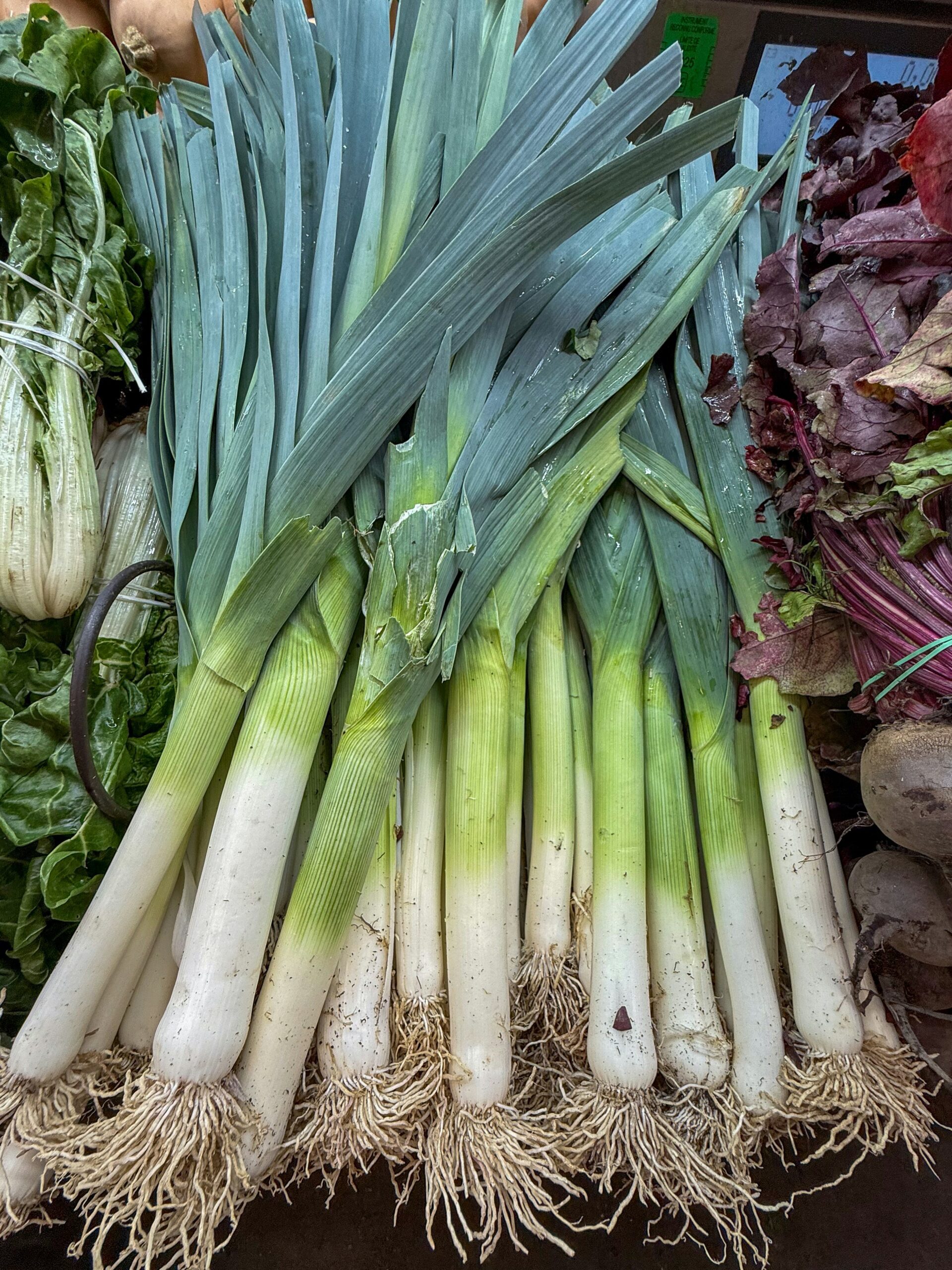
Learning how to grow leeks in the UK is one of the best decisions a kitchen gardener can make. How to grow leeks in the UK is less glamorous than growing tomatoes or courgettes — leeks don’t produce a dramatic harvest moment or a social-media-worthy abundance — but they fill a gap that almost no other homegrown vegetable can: fresh, flavourful produce straight from the ground through the heart of the British winter, when the kitchen garden is otherwise empty. Leeks stand in the ground from October to March, harvested as needed, unbothered by frost, and asking for almost nothing in return.
They’re also a genuinely forgiving crop. They tolerate poor soil better than most vegetables, don’t need particularly precise timing, and have very few serious pest and disease problems compared to their allium relatives like onions and garlic. For a beginner wanting to extend the growing season into winter, leeks are the most reliable starting point.
Choosing a Leek Variety
Leek varieties are broadly split by harvest season — early, mid-season, and late — and choosing across the range gives you leeks from September right through to April.
Early varieties such as King Richard and Jolant are harvested from late summer to early autumn. They’re long, slender, and mild-flavoured, excellent for fresh eating, but less tolerant of hard frost than mid and late varieties.
Mid-season varieties like Musselburgh — arguably the most widely grown leek in UK allotments and gardens — are harvested from October to December. Musselburgh is thick-stemmed, hardy, and has been reliable in the UK for over a century. Oarsman F1 is a modern equivalent with improved disease resistance.
Late varieties such as Bandit and Bleu de Solaise are the hardiest of all, standing through the coldest UK winters without damage and harvested from January through to March or even April. Bleu de Solaise turns an attractive blue-violet in cold weather and is one of the most frost-hardy vegetables available for UK growing.
For a first season, a mid-season variety like Musselburgh and a late variety like Bandit planted together gives you a six-month harvest window from one sowing.
How to Grow Leeks in the UK: Sowing from Seed
Leeks are started from seed — either indoors in late winter or directly outside in spring — and then transplanted to their final position in summer. This two-stage process sounds complicated but is entirely straightforward.
Sowing indoors (January to March) gives you the earliest possible harvest and allows you to get the seedlings going while outdoor conditions are still cold. Sow thinly in seed trays or modules of peat-free multipurpose compost at a depth of about 1cm. Place on a bright windowsill or in a frost-free greenhouse — leeks don’t need high temperatures to germinate, just freedom from hard frost. Germination takes ten to fourteen days at around 13–15°C.
Sowing directly outside (March to April) into a dedicated seedbed is the more traditional UK method. Sow thinly in rows 15cm apart at 1cm depth. Thin seedlings if they become overcrowded, and transplant to their final positions when they reach pencil thickness — usually June or July.
Indoor sowing produces plants ready to transplant earlier and allows more control over early growing conditions, which is worth the small extra effort.
Transplanting Leeks: The Traditional Method
Leeks are transplanted using a technique that is specific to them and produces the characteristic long white blanched stems.
When seedlings have reached about 20cm tall and pencil thickness — typically June or July — they’re ready to transplant. Water the seedbed well the day before to make lifting easier and reduce root damage.
The dibber method is the traditional UK approach. Use a thick dibber (or an old broom handle) to make holes 15cm deep and 15–20cm apart in rows 30cm apart. Drop one leek seedling into each hole, allowing the roots to fall to the bottom. Do not firm the soil around the plant — instead, water into the hole, which washes just enough soil around the roots to settle them without filling the hole. The hole remains open around the stem, and as the season progresses, the stem grows in the dark at the base of the hole, producing the white blanched lower portion that makes leeks so distinctive.
This sounds counterintuitive — planting into a hole and not filling it — but it works beautifully and is the reason homegrown leeks have a deeper and more generous white stem than anything available commercially.
Trim the roots slightly before transplanting if they’re very long — to about 2–3cm — which makes them easier to drop into the hole cleanly. Some gardeners also trim the leaf tips by a third to reduce water loss during establishment, though this isn’t essential.
Water well after planting and keep moist for the first two weeks while roots re-establish.
Earthing Up and Blanching
As leeks grow through summer and into autumn, you can extend the white blanched portion by earthing up — gradually drawing soil up around the stems as they grow. This excludes light from more of the stem, producing a longer white section and a milder flavour.
Earth up progressively by drawing soil toward the stems every few weeks from August onwards. Keep the soil level below the point where the leaves splay out (the leaf axils) to prevent soil getting between the leaves, which is frustrating to clean during preparation.
Some gardeners use cardboard tubes or sections of drainpipe slipped over the stems to blanch without earthing up — a cleaner method that avoids soil between the leaves entirely.
Feeding and Watering
Leeks are less demanding feeders than many kitchen garden crops. A soil improved with well-rotted compost or manure before transplanting provides the baseline nutrition most leeks need for the season.
If your soil is poor or the plants look pale and slow-growing by August, a nitrogen-rich liquid feed — a general-purpose liquid fertiliser or a diluted solution of nettles steeped in water — will green them up quickly.
Watering is important in the weeks immediately after transplanting, while leeks are re-establishing their root systems. Once established — usually by August — leeks are reasonably drought-tolerant and rarely need supplementary watering except in very dry autumns.
📖 Also read: How to Make Free Liquid Fertiliser from Weeds (And Why It Works Better Than You’d Think)
Harvesting Leeks
Harvest leeks as needed from October onwards, using a fork to loosen the soil around each plant before pulling — leeks anchor themselves firmly and pulling without loosening the soil risks snapping the stem.
Early varieties are best harvested promptly as they’re ready — they don’t stand as long as mid and late types and can become soft and strong-flavoured if left too long. Mid and late varieties can be left in the ground and harvested as needed through winter, which is one of the great practical advantages of growing leeks. Unlike most vegetables, they don’t need to be lifted and stored — the ground is the storage.
In severe frost, the outer leaves of leeks may freeze and become damaged, but the inner stem is almost always unaffected and perfectly edible. Simply peel back and discard the damaged outer leaves.
Leeks are finished when they start to bolt — sending up a flowering stem in spring. This usually happens from March onwards in early varieties, later in winter types. Once bolting begins, harvest quickly — the stem becomes increasingly tough and hollow as the flower develops.
Common Problems
Leek rust is the most common disease of leeks in UK gardens — orange pustules on the leaves, spreading from late summer onwards. It looks alarming but is rarely serious on an established crop. Remove badly affected outer leaves, avoid overhead watering, and improve airflow between plants. Modern varieties with improved rust resistance are worth choosing for gardens where the problem has been persistent.
Allium leaf miner has become a significant pest across much of England in recent years, particularly in the Midlands and south. The fly lays eggs in the leaves, and the larvae tunnel through them, leaving characteristic pale streaks and enabling secondary fungal infections. Cover plants with fine insect-proof mesh from sowing to harvest — it’s the only reliable prevention as there are no approved pesticide treatments.
Leek moth causes similar damage in some parts of southern England. Again, fine mesh exclusion is the most effective control.
Bolting in first-year plants is usually triggered by cold in very early-sown seedlings — plants sown indoors in January that experience prolonged cold can vernalise and flower prematurely. Avoid sowing too early and keep seedlings frost-free.
The RHS has a comprehensive guide to growing leeks with detailed variety recommendations and up-to-date guidance on allium leaf miner management, which is worth checking given how rapidly this pest has spread across UK growing regions.
📖 Also read: How to Grow Garlic in the UK — The Complete Month-by-Month Guide
Growing Leeks in Raised Beds and Containers
Leeks grow very well in raised beds, where the improved drainage and looser soil structure makes the dibber method particularly effective and harvesting significantly easier. A raised bed on a patio or allotment is an ideal leek growing environment.
Container growing of leeks is less common but achievable in large, deep containers — at least 30cm deep — using a good quality multipurpose compost. The yield per container will be modest, but for a gardener without a bed or allotment, a container of six to eight leeks is entirely practical.
📖 Also read: How to Build a Raised Bed Garden from Scratch — Everything a UK Beginner Needs to Know
Leeks in the Kitchen Garden Calendar
One of leeks’ most important roles in the UK kitchen garden is seasonal. They occupy the ground and provide harvest in the months when almost everything else is finished — October through to March — bridging the hungry gap between the end of the main summer season and the beginning of the following year’s growing.
Planted in June and July after earlier crops like broad beans, spring salads, or potatoes have been harvested, they make productive use of ground that would otherwise be empty for six months. This succession planting — using leeks to follow an earlier crop — is one of the most efficient ways to maximise the productivity of a limited growing space through the year.
Paired with a winter-hardy kale or chard, a row or two of leeks ensures that something can always be harvested from the garden, even on the coldest February morning when the idea of the summer garden feels very far away.
A Few Final Thoughts
Leeks are the quiet achievers of the British kitchen garden. They don’t produce the abundance of a courgette or the drama of a sunflower, but they do something arguably more valuable: they keep producing through the months when every other crop has finished, asking only for a well-prepared bed, a spring sowing, and occasional watering through summer.
For a beginner wanting to grow beyond the summer season — to have something genuinely homegrown to harvest in December and January — leeks are the most reliable and most rewarding starting point. A row of them standing green and frost-dusted in a January kitchen garden is one of the genuinely satisfying sights of the growing year.
Leave a Reply