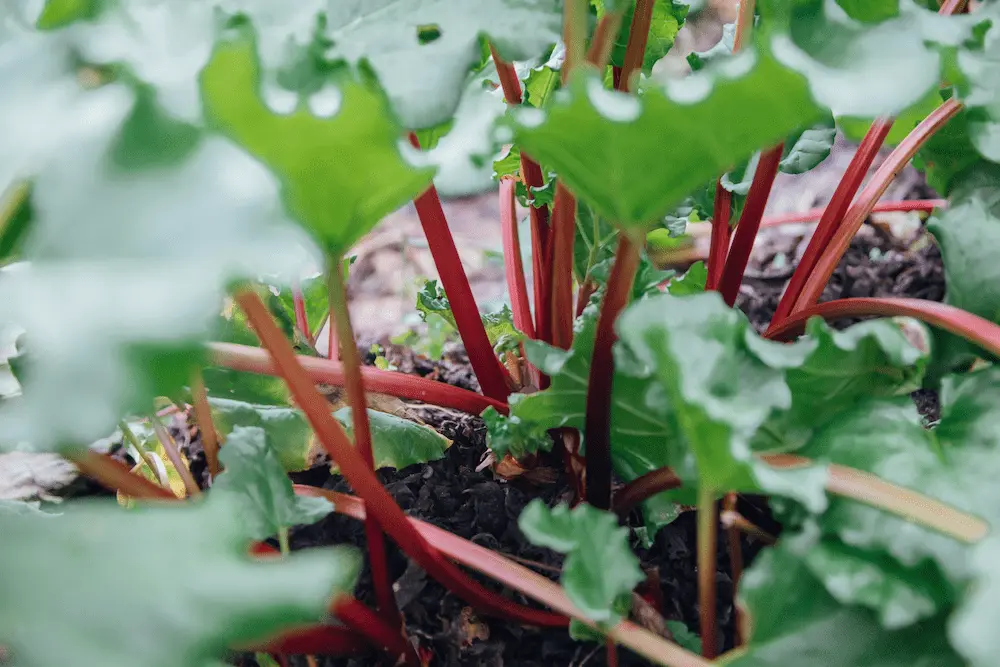
If you could only add one perennial to your kitchen garden this year, rhubarb would make a very strong case for itself. Plant a single crown in the right spot, and you will be harvesting from it for twenty years — possibly much longer. It asks for almost nothing in return: a mulch each spring, a bit of water in its first season, and the occasional removal of a flower stem. For that, you get armfuls of sharp, jewel-coloured stalks every spring, the earliest harvest in the kitchen garden, and the deep satisfaction of something that just gets better the longer you leave it alone. Learning to grow rhubarb in the UK is genuinely one of the best investments you’ll make in a productive garden.
Rhubarb is also almost absurdly well suited to the British climate. It’s completely hardy, it actually needs cold winters to perform well, and it thrives in the kind of damp, mild conditions that make many other crops miserable. From Yorkshire to Cornwall, it grows reliably — and in the famous Rhubarb Triangle between Wakefield, Morley, and Rothwell in West Yorkshire, it has been cultivated commercially for over a century.
📖 Also read: How to Grow Gooseberries in the UK
Why Rhubarb Is the Perfect UK Kitchen Garden Perennial
Rhubarb (Rheum × hybridum) is a hardy perennial that dies back completely in winter and re-emerges with enormous vigour in spring — one of the earliest edible crops to appear each year, often pushing up its first red shoots in February or March when the rest of the garden is still dormant. This early season presence is part of what makes it so valuable: rhubarb fills the hungry gap between the last of the stored winter crops and the first of the spring and summer harvests.
It forms a large leafy clump — mature plants easily reach 1.5m (5ft) across — with thick, red-tinged leaf stalks and enormous tropical-looking leaves. The leaves are poisonous (they contain high levels of oxalic acid) and should never be eaten, but they make excellent compost material and the stalks themselves are perfectly safe and delicious. In the garden, those big leaves provide useful ground cover that suppresses weeds under the plant.
Choosing the Best Rhubarb Variety
The variety you choose affects harvest time, stem colour, flavour, and suitability for forcing. For most UK gardeners, an RHS Award of Garden Merit variety is the safest starting point — these have been trialled and found to perform reliably across a range of conditions.
‘Timperley Early’ is the classic choice for forcing and the earliest outdoor harvest, producing stems from February onwards. ‘Raspberry Red’ AGM gives beautiful deep red stems with genuinely sweet flavour without needing to be forced — it crops heavily from April. ‘Fulton’s Strawberry Surprise’ AGM is similarly colourful with excellent flavour, ready in May and June. The old reliable ‘Victoria’ is a vigorous, high-yielding variety with greenish-red stems that’s been grown in British gardens for generations. For smaller spaces or containers, look for compact varieties specifically bred for restricted growing.
RHS Garden Bridgewater in Greater Manchester holds the National Plant Collection of culinary rhubarb, with over 100 varieties — well worth a visit in spring if you want to see the range before committing to a plant.
📖 Also read: How to Grow Beetroot in the UK — Easier Than You Think and Better Than the Jar
How to Plant Rhubarb Crowns in the UK
Rhubarb is most commonly bought and planted as bare-root crowns — the dormant underground rhizome with its growth buds intact — available from garden centres and mail-order suppliers from November through to March. Bare-root crowns are considerably cheaper than potted plants and establish just as well. Potted plants are available year-round but are better planted in spring or autumn rather than during hot, dry spells.
Choose an open, sunny site with fertile, moisture-retentive but well-drained soil. Rhubarb will tolerate light shade but produces better stems in full sun. Avoid frost pockets and poorly drained spots — waterlogged soil in winter can cause the crown to rot. Prepare the ground by digging in two generous bucketfuls of well-rotted garden compost or manure per square metre, and remove any perennial weeds thoroughly before planting.
Dig a hole wide enough to accommodate the roots comfortably and position the crown so that the tip — the pointed growing bud — sits just at or slightly above the soil surface. Burying the crown too deeply is the most common planting mistake and can lead to rotting. Firm the soil around the roots, water well, and space multiple plants 75–90cm (30–35in) apart. They look small at first but will fill their allotted space within a season or two.
The First Two Years — Patience Is the Key
This is where many new rhubarb growers struggle: you must resist harvesting in the first year after planting, and take only a very few stems in the second. It feels wasteful when the plant looks healthy and productive, but the restraint pays dividends. The plant is using those early seasons to build a strong root system that will sustain decades of harvests. Picking too heavily too soon weakens it permanently and drastically shortens its productive life.
By the third year, the plant is established and you can harvest normally — taking up to a third of the stems at any one time, pulling them by gripping at the base and twisting gently rather than cutting, which leaves a stump prone to rotting. Harvest from April through to late June or early July, then stop to allow the plant to rebuild its energy reserves through summer and autumn. For full variety and growing guidance, the RHS guide to growing rhubarb is thorough and highly practical.
📖 Also read: Easiest Vegetables to Grow in the UK for Beginners
How to Force Rhubarb for an Early Harvest
Forcing is the technique of excluding light from rhubarb crowns in midwinter to produce an early crop of pale, sweet, tender stems weeks ahead of the normal outdoor season. It’s the method behind the famous Wakefield forced rhubarb — grown in heated forcing sheds in complete darkness, producing the extraordinary candy-pink stems you see at farmers’ markets and fine food shops from January onwards.
In the garden, forcing is simple. In mid-winter (January is ideal), cover a healthy, established crown with a large opaque pot, a traditional terracotta forcing jar, or even an upturned dustbin. The key is to exclude all light. The plant, stimulated by warmth trapped under the cover and deprived of light, sends up etiolated (blanched) stems very quickly — typically ready to harvest within four to eight weeks. Forced stems are sweeter and more tender than outdoor stems and need far less sugar in cooking.
Only force an established plant (three years old or more), and don’t force the same plant two years in a row — it needs a full season to recover. Choose ‘Timperley Early’ for forcing if you can; it’s the variety specifically bred for this purpose and the one used commercially in the Rhubarb Triangle.
Ongoing Care and Keeping Plants Productive
Once established, rhubarb is remarkably undemanding. The main annual jobs are: applying a mulch of well-rotted compost each spring (keeping it away from the crown itself to prevent rotting), removing any flower stems the moment they appear — flowering weakens the plant and redirects energy away from stem production — and cutting back the faded leaves in autumn to expose the crown to winter cold, which it needs to trigger vigorous spring growth.
Every five years or so, divide the clump to keep it vigorous. Lift the entire plant while dormant, split it into sections with a spade, making sure each piece has a portion of rhizome and at least one strong bud, and replant the outer sections (which are more vigorous than the exhausted centre). Division not only rejuvenates the plant — it gives you free new crowns to expand your patch or share with neighbours, which is exactly how most allotment rhubarb gets passed down through generations.
📖 Also read: How to Improve Clay Soil in the UK
Common Problems and How to Avoid Them
Rhubarb is one of the most problem-free crops you can grow, but a few issues are worth knowing about. Slugs can damage young shoots in spring, particularly tender forced stems — a ring of sharp grit or copper tape around the forcing pot helps. Late frosts occasionally damage the first emerging shoots; if a sharp freeze is forecast after the plant has broken dormancy, covering with fleece overnight protects the vulnerable new growth. Split stalks are usually caused by erratic growing conditions — a cold dry period followed by a sudden warm wet spell — and are not a sign of disease; simply harvest and use the affected stems.
Rotting at the crown is the most serious potential problem, almost always caused by planting too deeply or growing in waterlogged soil. If you see die-back, cut it out promptly before it spreads. In persistently wet gardens, raised beds are the most reliable solution — the improved drainage makes an enormous difference to rhubarb’s long-term health and productivity.
A Plant for Life
There is something deeply satisfying about a plant that you put in the ground once, give a little time to establish, and then harvest from year after year with almost no effort. In a culture of annual replanting and seasonal turnover, rhubarb is a quiet act of permanence — a plant that rewards patience and gets better with age. Give it a good site, a handful of compost each spring, and enough restraint to leave it alone in its first two years, and it will still be producing for you long after everything around it has been dug up and replanted a dozen times.
📖 Also read: How to Grow Blackcurrants in the UK
Leave a Reply