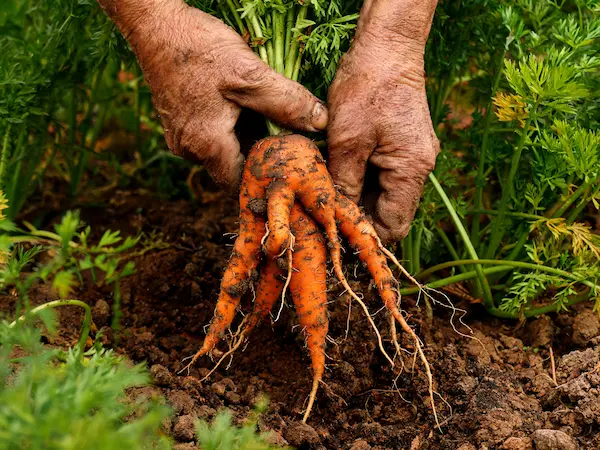
Carrots are one of those vegetables that seem like they should be simple — tiny seeds, a bit of soil, a few months of patience — and yet they have a particular talent for humbling even experienced gardeners. The seed germinates patchily. The seedlings disappear overnight. And then when you finally pull your first roots in late summer, half of them look like something from a novelty vegetable competition: forked, twisted, multi-legged, and barely recognisable as a carrot. To grow carrots in the UK well, you need to understand a few specific things about what they want from their soil and their growing conditions — and once you do, they’re genuinely one of the most satisfying crops in the kitchen garden.
The good news is that home-grown carrots, however they look, taste dramatically better than anything in a supermarket bag. There’s a sweetness and intensity in a carrot pulled fresh from the ground that no amount of cold-chain logistics can replicate. That alone is worth working through the learning curve.
📖 Also read: How to Grow Parsnips in the UK — The Most Rewarding Winter Root Vegetable
Why Do Carrots Fork? The Real Reasons
This is the question everyone asks, and the answer is almost always the same: the soil. Carrots fork when the taproot encounters an obstacle as it grows downward — a stone, a hard clod, a pocket of compacted subsoil, or a lump of fresh manure or compost. The root tip divides and grows around the obstruction, producing the classic multi-legged result. It’s not a disease, it’s not a pest, and it’s not bad luck. It’s a soil preparation problem.
The fix is thorough ground preparation before sowing. Fork the bed to at least 30cm (12in) deep, removing every stone you can find, breaking up hard lumps, and raking to a fine, crumbly texture. Do not add fresh manure or compost immediately before sowing — this is one of the most common mistakes. Freshly incorporated organic matter creates exactly the kind of rich, uneven pockets that carrot roots divide around. Instead, use ground that was manured the previous autumn and has had months to settle and integrate.
If your soil is heavy clay, very stony, or shallow, no amount of preparation will give you long, straight roots consistently. The solution is to choose short-rooted varieties specifically bred for difficult soils — ‘Paris Market’ (round-rooted), ‘Chantenay Red Cored’, and other stubby types grow beautifully in conditions that would destroy a long-rooted Nantes or Imperator type. Alternatively, grow in deep containers of peat-free multipurpose compost, where you control the growing medium entirely. Many UK allotment gardeners with heavy clay have switched entirely to container carrots for this reason and produce excellent results.
Choosing the Right Carrot Variety for UK Growing
Carrot varieties fall into broad groups based on root shape and sowing season. Early varieties — sown from February or March under cloches, or from April outdoors — are typically shorter, faster-maturing, and excellent as baby carrots. ‘Adelaide’ AGM and ‘Nantes 2’ are reliable early choices, producing smooth, sweet roots from June onwards. Main-season varieties sown from April to July give you the larger, full-flavoured roots that store well into autumn and winter; ‘Sweet Candle’ AGM and ‘Sugarsnax 54’ AGM both performed exceptionally well in RHS trials.
For problem soils, the round-rooted ‘Paris Market Atlas’ is almost foolproof — its short, globe-shaped roots have almost nothing to fork around. ‘Chantenay Royal’ is another excellent choice for heavier ground. Some varieties, including ‘Flyaway’ and ‘Resistafly’, offer partial resistance to carrot fly — a significant practical advantage if your plot is in an area where the pest is persistent.
📖 Also read: How to Grow Beetroot in the UK — Easier Than You Think and Better Than the Jar
Sowing Carrots in the UK — Getting Germination Right
Carrots must be sown directly where they are to grow. Unlike most vegetables, they form a taproot immediately after germination and simply cannot be transplanted without destroying that root and producing forked, distorted results. No modules, no trays, no transplanting — sow the seed in its final position and thin in situ.
The main sowing season runs from April to early July in most of the UK. Early varieties can go in from February under cloches or fleece, but cold, wet soil before April is one of the main reasons carrot germination is poor — the seed sits dormant, rots, or germinates so slowly that weeds swamp it. Waiting until the soil has warmed to at least 7–10°C (mid-April in most of England) produces far more reliable germination than an optimistic February sowing.
Sow into a shallow drill about 1cm (½in) deep, as thinly as you possibly can — carrot seed is small enough that this takes practice. Water along the base of the drill before sowing in dry weather. Cover lightly, firm gently, and water again. Germination takes one to three weeks depending on temperature. Thin seedlings to 5–7.5cm (2–3in) apart once they’re established — overcrowding produces thin, distorted roots and increased competition for water. Sow a fresh row every three to four weeks for continuous harvests from June through to November.
The Carrot Fly Problem — and How to Solve It
Carrot fly (Psila rosaria) is the most serious pest threat to UK carrot crops, and understanding it makes it completely manageable. The adult fly lays its eggs near carrot plants, attracted by the scent released when carrot foliage is bruised or crushed. The larvae tunnel into the roots, leaving rust-coloured channels that rot and render the carrot inedible.
Crucially, carrot fly is a low-flying insect — it rarely flies above 60cm (2ft). A simple barrier of fine insect-proof mesh draped over the crop from sowing time, supported on hoops, excludes the fly entirely and is the most reliable protection available. You can also use a physical barrier of clear polythene or fleece at least 75cm tall around the bed — high enough to exclude the fly without mesh over the plants themselves.
Timing also helps: late-sown carrots (after mid-May) miss the first generation of carrot fly, while harvesting before late August avoids the second. Avoid thinning on warm evenings when carrot fly is most active, and don’t leave thinnings lying on the soil surface — they release exactly the scent that attracts the pest. For detailed guidance on growing and protecting carrots, the RHS guide to growing carrots covers carrot fly management and variety selection comprehensively.
📖 Also read: Blight on Tomatoes and Potatoes in the UK
Watering, Weeding, and General Care
Established carrots are more drought-tolerant than most vegetables — their deep taproot accesses moisture well below the surface. In most UK summers they need little or no watering once established. The main exception is containers, which dry out quickly and need watering regularly, and very prolonged dry spells where roots risk splitting when rain finally arrives after a dry period. Consistent moisture is the goal: not constant watering, just preventing extreme wet-dry cycles.
Weeding is most critical in the first few weeks after sowing, when slow-germinating carrot seedlings are easily outcompeted. Hoe between rows when the soil surface is dry, but hand-weed close to the plants — a hoe blade catching the top of a young root damages it and, as with parsnips, creates an entry point for rot. Try not to brush the foliage as you weed; the released scent attracts carrot fly, and it’s wise to replace insect-proof mesh immediately after every weeding session.
Harvesting and Storing Carrots
Carrots are ready to harvest from about 12–16 weeks after sowing, depending on variety. For early and baby varieties, start pulling as soon as they’re large enough to use — young carrots have the most intense sweetness and flavour, and there’s no benefit to leaving them longer once they’ve reached eating size. For main-season varieties, harvesting through summer and into early autumn is ideal; left too long, roots become coarse and the flavour declines.
In the ground, main-crop carrots can be left through winter and lifted as needed — cover the row with straw or cardboard before the first frosts to insulate the soil and prevent the ground freezing solid. In waterlogged soils, lift the whole crop in November and store in boxes of damp sand or dry compost in a cool shed or garage. Stored this way, carrots keep in excellent condition for several months — one of the most satisfying aspects of growing your own is opening a box of stored carrots in February and finding them as fresh as the day they were lifted.
📖 Also read: Easiest Vegetables to Grow in the UK for Beginners
The Secret to Straight Carrots
If there’s one thing to take from this guide, it’s that straight carrots are made before sowing, not during growing. Every minute you spend preparing the soil — removing stones, breaking up clods, raking fine, resisting the urge to add fresh compost — pays back in roots that actually look like carrots rather than abstract sculptures. Get the soil right, choose the variety for your conditions, cover against carrot fly, and sow thinly in warm soil from April onwards. The rest takes care of itself.
Leave a Reply